
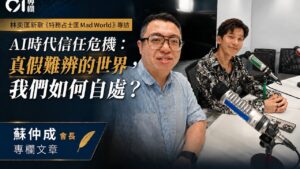
In Conversation with Phil Lam on ‘Mad World’: AI, Cybersecurity and Humanity
Not long ago, as the host of a Metro Broadcast radio programme, I sat down
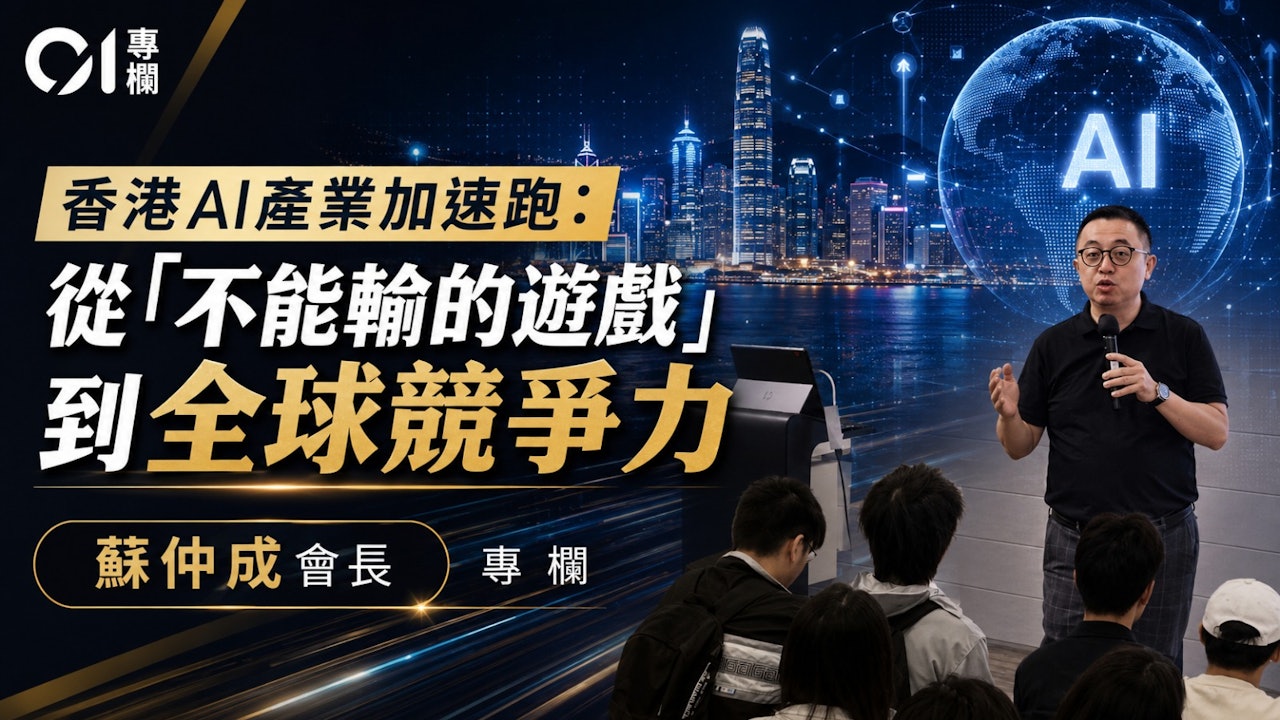
By Michael C.S. So │ AiX Society
While researching for a sharing session with university students from Mainland China, hosted last week by the Hong Kong Productivity Council (HKPC), I mapped out the latest developments in Hong Kong’s AI industry. The audience was a group of bright young students from top-tier mainland universities, full of curiosity about Hong Kong’s AI ecosystem and brimming with sharp questions. It was in preparing for this session that I took a fresh look at where Hong Kong stands — and how far it could go — on the AI track.
To understand where Hong Kong’s AI industry stands, start with a few key figures. In 2026, the global AI market is expected to exceed US$900 billion. On this trillion-dollar track, Hong Kong’s total computing power has already reached 5,000 PFLOPS (a quadrillion floating-point operations per second) — the equivalent of processing nearly 10 billion images every hour.
This did not materialise out of thin air. The AI supercomputing centre that came into service in December 2024 offers 3,000 PFLOPS of computing power and is already running at over 90% utilisation. Even more striking is the Sha Ling data park in the Northern Metropolis, which by 2032 will deliver 180,000 PFLOPS — 36 times Hong Kong’s current capacity. In other words, Hong Kong’s computing infrastructure is expanding at an exponential pace.
Behind this lies a systematic strategy from the HKSAR Government. Since the release of the Hong Kong Innovation and Technology Development Blueprint at the end of 2022, AI has been explicitly designated a competitive-advantage industry. The 2025 Policy Address went further, elevating AI to a “core industry” and establishing the guiding principle of “industrialising AI and infusing AI into industry”. In the 2026–27 Budget, Financial Secretary Paul Chan went a step further by proposing an “AI+ and Industrial Development Strategy Committee” chaired by himself, initially focused on life and health sciences and embodied intelligence.
The funding is equally substantial: HK$10 billion for the Innovation and Technology Industry Guidance Fund, HK$3 billion for the AI Subsidy Scheme, HK$3 billion for the Frontier Technology Research Support Scheme, and HK$1 billion for the Hong Kong AI Research Institute. Together, these tens of billions of Hong Kong dollars make clear that the Government’s commitment to AI is far from rhetorical.
Hong Kong’s distinctive edge in AI research lies in its cluster of world-class universities. Hong Kong is the only city in the world with five universities in the global top 100, and in the 2025 QS World University Rankings by Subject, all five ranked among the world’s top 50 in data science and AI — the largest number in Asia. The Hong Kong University of Science and Technology led the city at 17th globally, followed by the University of Hong Kong at 18th and the Chinese University of Hong Kong at 19th.
This clustering effect gave rise to HKGAI — the Hong Kong Generative AI Research and Development Centre and the city’s first home-grown large language model. Established in October 2023 and funded through the Government’s InnoHK platform, HKGAI is led by HKUST with the participation of several universities. It released the HKGAI V1 model in February 2025 and, by the end of 2025, launched “Cantonese Chat” (港話通), an intelligent chatbot that attracted over 500,000 registered users in its first month with more than 30,000 conversations a day. Its companion, “Official Text Assistant” (港文通), a document-writing assistant that has learned Hong Kong’s official writing style, is already serving nearly 50,000 civil servants. HKGAI V3, released in June 2026, aims to become the “digital Hongkonger” that best understands the city’s government and businesses.
Professor Guo Yike, Director of HKGAI, offers a sharp analogy: “Pre-training a large model is like raising a child — no matter how strong its general capabilities, if it is not aligned with local regulations and social values, it will never learn to ‘know its limits’.” That is precisely the philosophy behind Hong Kong’s home-grown model: not to simply copy Silicon Valley or Shenzhen, but to build an AI that genuinely “understands Hong Kong”.
Among commercial applications in Hong Kong, finance is the most mature. In March 2026, the Hong Kong Monetary Authority upgraded its Generative AI sandbox to “GenA.I. Sandbox++”, covering six segments including banking, securities, asset management and insurance. A second batch of 27 pilot projects launched in early 2026, involving six licensed banks and covering scenarios such as multimodal AI for optimising loan approval, real-time anti-fraud systems targeting deepfakes, and multilingual intelligent customer service.
In practice, HSBC used the GenA.I. sandbox to launch a “frictionless” customer experience programme in which self-service account opening can be completed in as little as 15 minutes. Huawei’s “all-in-one smart banking application machine” can generate a report in financial analysis scenarios in as little as eight minutes, with question-answering accuracy above 95%. WeBank has deployed more than 100 AI application scenarios and over 700 agents, with more than 50 “digital employees” now on the job. A PwC report notes that AI is evolving from an “efficiency tool” in financial institutions into a “core engine of strategic transformation”, with large-model penetration in the financial sector expected to reach 68% in 2026.
Beyond finance, AI is penetrating other sectors rapidly. In healthcare, Hong Kong Polytechnic University has used the supercomputing centre to develop precision treatment for hepatocellular carcinoma based on a multimodal large language model, improving information accuracy by 28%; AI-assisted diagnostic systems have already exceeded 60% penetration in primary-level hospitals. In retail, in 2026 Hong Kong’s Hung Hom waterfront welcomed the city’s first fully autonomous overseas robot retail store, where robots not only act as store managers but also enable round-the-clock operation, multilingual service, intelligent shopping guidance and automated checkout — widely seen as an important signal of the “first year of commercialised physical AI”.
In public services, around 70 government departments are already trialling the HKGAI large-model office assistance system, with the goal of rolling out AI tools covering 100 government service processes in 2026 and expanding to no fewer than 200 by the end of 2027. “Cantonese Chat” supports trilingual interaction in Cantonese, English and Putonghua, while “Official Text Assistant” has learned Hong Kong’s official document formats — together driving the digital and intelligent transformation of government.
Looking ahead, six trends deserve attention. First, the shift from “tools” to “agents” — the rise of AI agents. 2026 is widely seen as the first year of AI-agent commercialisation, as AI moves from passively executing instructions to actively understanding tasks, autonomously decomposing workflows and collaboratively achieving goals. Gartner predicts that by the end of 2026, around 40% of enterprise applications will integrate task-oriented AI agents.
Second, the shift from “digital” to “physical” — the explosion of embodied intelligence. AI is acquiring a body and entering the real world: robot store managers, robot shopping guides, industrial robots, medical robots. In May 2026, the first Hong Kong Embodied Intelligence Industry Summit was held and the city’s first full-stack embodied intelligence laboratory was established, working with 24 industry partners with the goal of enabling robots to perform a wide range of tasks in both consumer services and industrial settings.
Third, the shift from “unimodal” to “multimodal”, from “cloud” to “edge”, from “general-purpose” to “vertical”, and from “industrialising AI” to “infusing AI into industry” — together these trends outline the next stage of AI’s development.
Why does Hong Kong have a chance to win this race? Six distinctive advantages stand out: the institutional advantage of “one country, two systems” connecting the nation to the world; an international financial centre that brings abundant capital; five universities in the global top 50 for AI forming a world-class research cluster; the intersection of Chinese and Western cultures nurturing international talent in a multilingual environment; a robust rule-of-law framework and cross-border data mechanisms that safeguard security; and Greater Bay Area coordination that aligns research with the industrial chain.
Professor Guo Yike once proposed the “DJI innovation model” as an analogy: Hong Kong handles cutting-edge research (basic research), Shenzhen handles product development and iteration, the Pearl River Delta handles mature production lines and mass manufacturing, and the global market handles market expansion. This model can be replicated entirely in AI — Hong Kong’s research plus the Greater Bay Area’s industrial chain equals global competitiveness.
Of course, challenges remain: a scarcity of interdisciplinary talent who understand both business and algorithms, uneven data quality across enterprises, the need to balance innovation with risk, and the fact that only some organisations have built an “AI-first” culture. But as Secretary Sun Dong put it, this is “a game we cannot afford to lose”.
The question is not “will AI change my industry?”, but “how do I proactively embrace AI and become a beneficiary of change?”. Industrialising AI, infusing AI into industry — this is not only Hong Kong’s strategy, but an action guide for every enterprise and every individual.
Originally published in Chinese on HK01 (香港01). Read the original article
Not long ago, as the host of a Metro Broadcast radio programme, I sat down
The reaction made me reflect: what people care about most is not how powerful AI
By Michael C.S. So │ AiX Society While researching for a sharing session with university
HKOEA Consultancy
Licence No. 59684
© 2026 Artificial Intellegence Application Research Society. All rights reserved
by Originals Group – Hong Kong, Malaysia, GBA