
In Conversation with Phil Lam on ‘Mad World’: AI, Cybersecurity and Humanity
Not long ago, as the host of a Metro Broadcast radio programme, I sat down
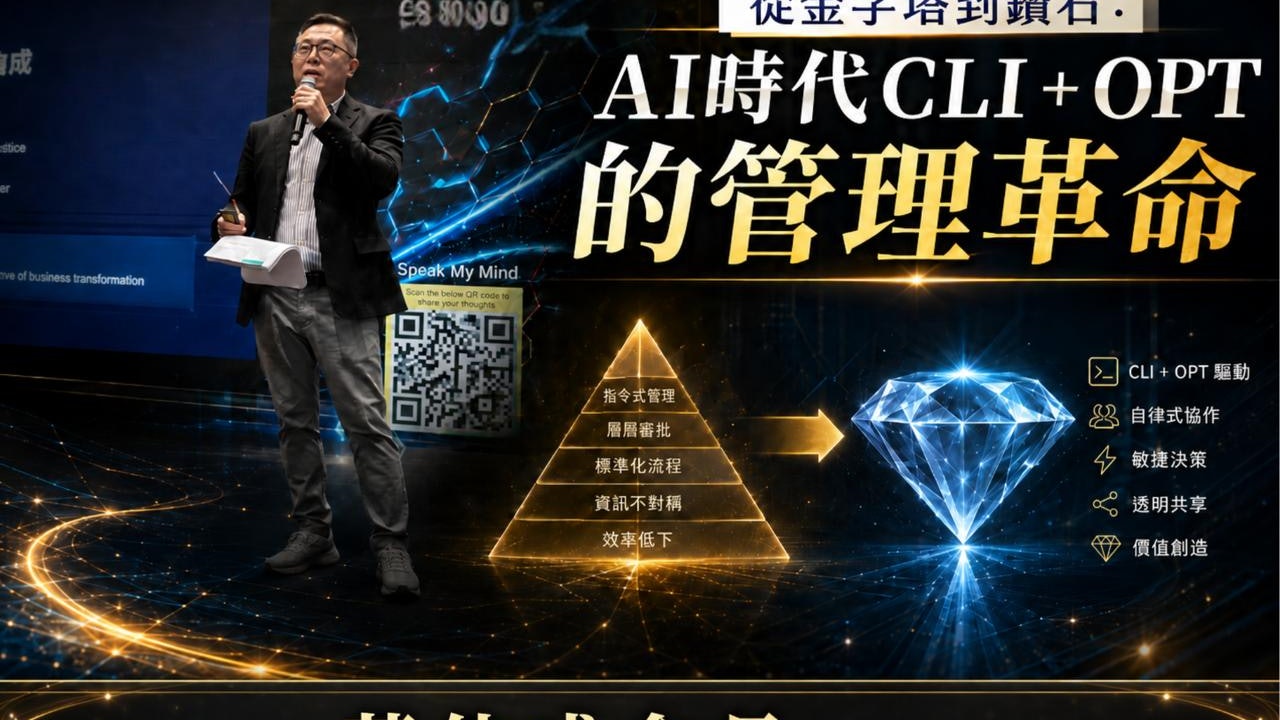
The reaction made me reflect: what people care about most is not how powerful AI is, but how our ways of working and management structures are about to be rewritten.
By Michael C.S. So │ AiX Society
The traditional enterprise structure is a standard pyramid.
At the base sits a large layer of front-line executors — responsible for repetitive tasks such as data entry, report compilation, basic customer service and document processing. In the middle are managers, responsible for relaying instructions, coordinating resources and tracking progress. At the top are the decision-makers who set direction and strategy.
This structure worked well in the industrial age: standardised production required a large labour force, information flowed upward for reporting, and directives were passed downward for execution. Each layer had its function, and the whole system operated for more than a century.
Yet this structure produced a great many “porter” roles — colleagues doing repetitive work day after day whose creativity and judgement were never truly unleashed. At the same time, middle managers often served merely as “messengers”, organising and passing information upward and relaying decisions downward. This process consumed enormous amounts of time and human resources, while the strategic thinking that truly matters was often drowned out by day-to-day coordination.
The more fundamental problem is this: the pyramid assumes information should flow from bottom to top and decisions from top to bottom. In today’s era of information explosion, this one-way flow has become inefficient. Front-line colleagues hold the most up-to-date market intelligence, yet it must pass through multiple layers before reaching decision-makers; and by the time a decision-maker’s directive filters down through the layers, it may already be outdated. This is the fundamental contradiction of the pyramid structure in the digital age.
CLI (Conversational Language Interface) is the first piece of the puzzle in understanding this transformation.
For the past four decades, we have lived in the world of the GUI (Graphical User Interface). From Windows to macOS, from iOS to Android, we have grown accustomed to interacting with machines through mouse clicks and finger taps. The typical path to completing a task is: open the software → click through menus → choose a path → adjust the format → save. The process seems simple enough, but when you are handling a hundred documents, repeating the same motions every day and switching between different systems, the efficiency problem quickly surfaces.
The essence of the GUI is that “humans adapt to machines” — we are forced to learn the machine’s logic, memorise cumbersome steps and endure unintuitive interface designs. Every piece of software has its own way of doing things, and every version update may move a button. We spend a great deal of time learning how to use tools, rather than using tools to create value.
The arrival of CLI changed all of this.
CLI lets users express their intent to a system directly in natural language, and the system automatically understands, plans and executes the task. Take producing a quarterly sales report, for example. Previously you had to: log into the CRM system → search for customer data → export to Excel → open Excel to format it → create charts → write up the analysis → export to PDF. The whole process could take thirty to sixty minutes.
Today, you need only say: “Analyse the purchasing trends of my top ten customers last quarter and generate a report.” An AI agent will then automatically complete the following steps:
First, invoke tools — connect to your systems and databases to obtain raw data. This is not simple copy-and-paste, but secure authentication and data exchange with enterprise systems via APIs.
Second, plan the path — identify key metrics, clean anomalous data and ensure data quality. The AI judges which data fields are relevant, which should be excluded, and which need format conversion.
Third, execute operations — generate professional trend charts and an analysis report, complete with textual insights. This includes choosing the most appropriate chart type, annotating key data points and writing up analytical conclusions.
Fourth, deliver the result — send the document directly to your inbox, or generate a shareable link.
The essence of CLI is that “machines adapt to humans”. You express your intent in natural language, and the AI handles the execution details. This is not magic, but a fundamental shift in the interaction paradigm — turning us from “operators” into “commanders”.
OPT (One-Person Team) is the second piece of the puzzle.
The core idea of OPT is not that one person does everything, but that a single person commands a team of AI “digital employees” through CLI. In the past, completing a project required a data analyst, a copywriter, a designer, a project manager and more — each a specialist, with extremely high coordination costs. Today, you need only one person plus a portfolio of AI skills.
Let me illustrate with a concrete example. Suppose you need to produce a quarterly e-commerce operations report:
First, a data-extraction agent — automatically connects to your Shopify or Tmall backend and pulls sales data. It extracts precisely the data you need according to the parameters you set, such as time range, product category and customer segment.
Second, a data-analysis agent — identifies growth points, outliers and shifts in user profiles. It does not merely calculate numbers; it performs year-on-year and period-on-period analysis to uncover the drivers behind the trends.
Third, a visualisation agent — automatically generates trend charts, pie charts, bar charts and more based on the data highlights. It selects the most suitable chart type to present each dimension of the data.
Fourth, a copywriting agent — writes professional analytical conclusions and recommendations based on the data insights. It adjusts the tone and level of detail to suit your target readers.
Fifth, a layout and output agent — brings everything together into a polished PDF or PPT with consistent formatting and style.
Throughout the process, you need only say: “Generate last quarter’s e-commerce operations report for me, with a focus on why the repurchase rate fell.” Then you can devote yourself to higher-level thinking — such as the market trends behind the numbers, or the next step in your business strategy.
This is not science fiction. According to Anthropic CEO Dario Amodei’s prediction, the probability of a “one-person unicorn” (a single-founder company valued at US$1 billion) emerging in 2026 is as high as 70% to 80%. Data from Carta also shows that the share of solo founders among new startups has risen from 23.7% in 2019 to 36.3% in 2025. Real-world examples abound: a developer in China who orchestrates five AI agents in concert to earn US$320,000 a year; a factory safety trainer in Guilin earning only US$800 a month who built a digital app serving the US market, generating a substantial income.
This is the power of OPT — it lets everyone become a “one-person company”, serving multiple clients through AI and maximising individual value.
Realising CLI and OPT requires the support of several layers of technical architecture.
First, the large language model (LLM) as the core engine. Trained on massive datasets, these models can grasp the nuances of natural language — context, intent, even tone. They understand not only the literal meaning but also the needs a user implies without stating.
Second, the agent framework. This is a coordination layer responsible for breaking a user’s single instruction into multiple sub-tasks, distributing them to different AI agents and tracking each agent’s progress. When an agent runs into a problem, the framework automatically adjusts its strategy or requests human intervention.
Third, tool-calling capability. AI agents need to connect securely to external systems — databases, APIs, enterprise software — and operate within an authorised scope. This involves enterprise-grade security mechanisms such as authentication, permission management and data encryption.
Fourth, memory and context management. A good AI agent can remember past conversations and preferences, continually improving the quality of its output over time. It is like a colleague who knows your working habits — the longer you collaborate, the more efficient it becomes.
Layered together, these four levels of architecture form a complete OPT ecosystem. At the top, the user issues instructions in natural language; the LLM understands the intent; the agent framework decomposes the task; the tool-calling layer executes the operations; and the memory layer keeps learning and optimising.
Having understood the technical foundations of CLI and OPT, we can now return to the original observation at the heart of this piece — the diamond-shaped organisation.
If a pyramid is a triangle — wide at the base and narrow at the top — then the diamond shape is widest in the middle and tapering at both ends.
In a diamond-shaped structure:
The base (the execution layer) shrinks dramatically — repetitive, low-value work is taken over by AI agents. Data entry, report compilation and basic customer service that once required a hundred people can now be done automatically by AI. This is not merely an efficiency gain but a structural change — the execution layer no longer needs to occupy most of the organisation’s resources.
The middle (the management layer) becomes leaner — information alignment and progress tracking are assisted by AI. A single AI agent can monitor the progress of dozens of projects at once, automatically detecting risks and issuing real-time alerts. Coordination that once required multiple middle managers can now be automated to a large extent. The manager’s role shifts from “supervising execution” to “guiding strategy”.
The upper-middle (the professional and decision-making layer) expands greatly — this is the widest part of the diamond. Here gathers a large number of experts, strategists and innovators. Because the work of the execution and middle layers is automated, more people can be promoted into higher-value roles, engaging in strategic thinking, innovation and R&D, and client relationships — high value-added work.
This shift means that the essence of management changes from “control” to “empowerment”. In the past, the main job of management was to ensure that subordinates executed tasks correctly; in the future, it will be to ensure that AI and humans collaborate smoothly, and to create the best conditions for the team to focus on high-value judgement and decision-making.
Hong Kong’s corporate structures have traditionally relied heavily on pyramid-style management. In e-commerce, trading and retail in particular, many processes are still handled manually, with approvals stacked layer upon layer.
Yet the emergence of CLI and OPT offers Hong Kong enterprises a unique opportunity. Our strengths are agility, international outlook and a willingness to embrace new things; our weaknesses are high labour costs and the low efficiency of traditional management. AI helps us resolve precisely this contradiction — raising efficiency through technology while unleashing our colleagues’ creativity so they can take on higher-value work.
This is not asking everyone to overturn the existing structure overnight; rather, it is an invitation to start thinking: how much of your team’s work is repetitive? How much could be assisted by AI? If that time were freed up, what more valuable outcomes could your colleagues create?
After the sharing session, a colleague said to me: “It turns out what I fear most is not AI taking my job, but that I am still using old methods to deal with the matters of a new era.”
That remark stayed with me.
AI is not here to replace humans, but to liberate them — freeing us from tedious, repetitive, low-value labour so that we have more time to think, to create and to connect.
And the shift of the management structure from pyramid to diamond is the concrete embodiment of this liberation. When the execution layer is automated and the management layer is assisted by AI, the most precious resource — human creativity and judgement — is released to where it delivers the highest value.
This is not a distant future; it is happening now.
Are you ready to step out of the pyramid and into the diamond?
Originally published in Chinese on HK01 (香港01). Read the original article
Not long ago, as the host of a Metro Broadcast radio programme, I sat down

The reaction made me reflect: what people care about most is not how powerful AI

By Michael C.S. So │ AiX Society While researching for a sharing session with university
HKOEA Consultancy
Licence No. 59684
© 2026 Artificial Intellegence Application Research Society. All rights reserved
by Originals Group – Hong Kong, Malaysia, GBA