
In Conversation with Phil Lam on ‘Mad World’: AI, Cybersecurity and Humanity
Not long ago, as the host of a Metro Broadcast radio programme, I sat down
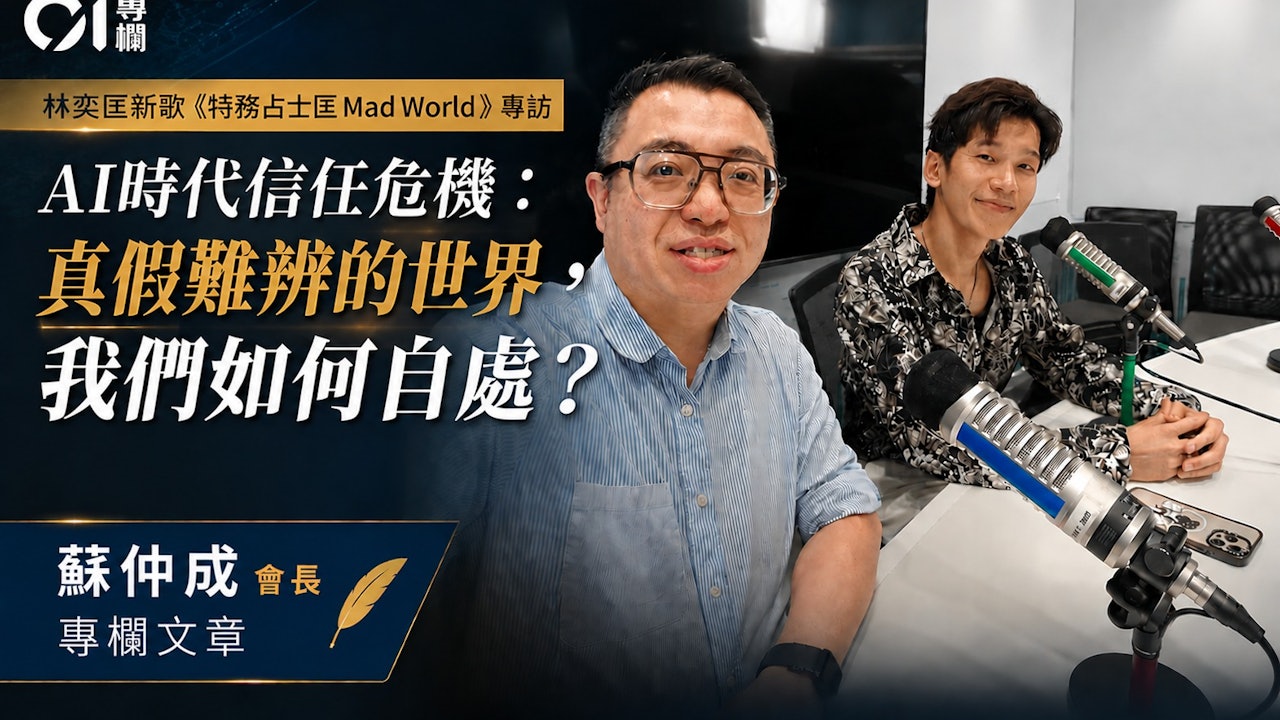
Not long ago, as the host of a Metro Broadcast radio programme, I sat down for an interview with Phil Lam about his new song “Mad World”. I had expected it to be a work with a touch of humour and self-deprecation, but the more I listened and the more we talked, the heavier my heart felt.
By Michael C.S. So │ AiX Society
Because I realised that the world the song depicts bears a startling resemblance to the AI era we are living in today.
The protagonist of the song seems to inhabit a world where truth and falsehood are intertwined, where one is watched, judged and misunderstood at every moment. Every word and every action can be magnified, distorted, or even re-interpreted.
This is a feeling that many artists, creators and even ordinary people are becoming increasingly familiar with.
Because with the rapid advance of artificial intelligence, anyone can become the next victim.
In my conversation with Phil, I sensed a certain resignation in him as a creator.
That resignation comes not only from market competition, but from an era in which even reality itself has begun to be questioned.
Today, a voice can be replicated by AI;
a photo can be altered by deepfake;
an interview can be edited beyond recognition;
and even a person’s voice, expressions and image can be regenerated by artificial intelligence.
Many performers, singers, hosts, KOLs, and even journalists and columnists, face an unprecedented challenge:
when content can be mass-produced by machines, and when hatred and malice can be amplified without limit on social platforms, a creator’s greatest enemy may no longer be a shortage of creativity, but the loss of “authenticity” itself.
To some extent, “Mad World” gives voice not just to Phil Lam’s own feelings, but to the shared anxiety of creators worldwide.
In the past, when people spoke of cybersecurity, they thought of viruses, ransomware and hackers.
But today, I increasingly believe that the greatest cybersecurity crisis of the future is, in fact, “trust”.
Because AI is turning “seeing is not necessarily believing” into reality.
The voice you hear may not be a real person;
the video you watch may never have happened;
the WhatsApp voice message you receive may simply be AI imitation.
In recent years, cases of fraud using AI face-swapping and voice cloning have appeared in Hong Kong, the mainland and overseas — there was even an employee of a multinational company who transferred tens of millions of US dollars after attending a video conference in which senior executives were faked by AI.
As truth and falsehood become ever harder to tell apart, the foundation of trust on which our society runs is beginning to be shaken.
This is the real cybersecurity problem of the AI age.
Reassuringly, the tech world is not sitting idly by.
Companies such as OpenAI, Adobe and Microsoft are advancing content-credential technology, using digital watermarks and content provenance to allow images, videos and audio to prove their origin.
In the future, we may check whether a video has been authenticated just as we check the HTTPS padlock today.
But I believe technology can only solve half the problem.
The other half must be done by people.
The most important capability of the future is not “seeing news fastest”, but “sharing slowest”.
When you see a shocking video or an infuriating message, pause for a moment and think.
Because your single share could become another person’s disaster.
Use two-factor authentication, change your passwords regularly, and avoid exposing too much personal data.
Voice, video and large numbers of everyday photos in particular may all become raw material for AI training in the future.
Your digital identity will become as important as your ID card.
In the age of social media, many people have grown used to hiding behind a screen.
A malicious comment, a mocking emoji, a share taken out of context — these may seem like mere “fun”.
But every instance of harm can land on a real person.
Today we laugh at someone else being faked by AI;
tomorrow, it could be our turn.
No one can guarantee they will always remain a bystander.
After hosting that programme, I kept turning over the feeling that “Mad World” left behind.
That contradiction — light on the surface, lonely underneath — is, in fact, the reality that many creators, performers and even ordinary people face together today.
Technology is racing ahead, while human ethics, law and civilisation are still struggling to catch up from behind.
Perhaps one day, each of us will experience:
our own voice being misused;
our own photos being altered;
our own words being distorted;
or even being attacked by a group of people we have never met.
Only then will we understand:
cybersecurity is not just about firewalls and passwords.
What truly needs protecting is the trust between people.
And in the AI age, the most important security software has never been an algorithm.
Written after the Metro Broadcast music programme, in conversation with Phil Lam on “Mad World”.
Originally published in Chinese on HK01 (香港01). Read the original article
Not long ago, as the host of a Metro Broadcast radio programme, I sat down

The reaction made me reflect: what people care about most is not how powerful AI

By Michael C.S. So │ AiX Society While researching for a sharing session with university
HKOEA Consultancy
Licence No. 59684
© 2026 Artificial Intellegence Application Research Society. All rights reserved
by Originals Group – Hong Kong, Malaysia, GBA