
Embracing the Future: AIX Society Applauds Hong Kong’s 2026 Budget and Pledges to Co-create a New AI Era
AIX Society applauds the Hong Kong AI Budget 2026, welcoming HK$100M+ in AI investments, an
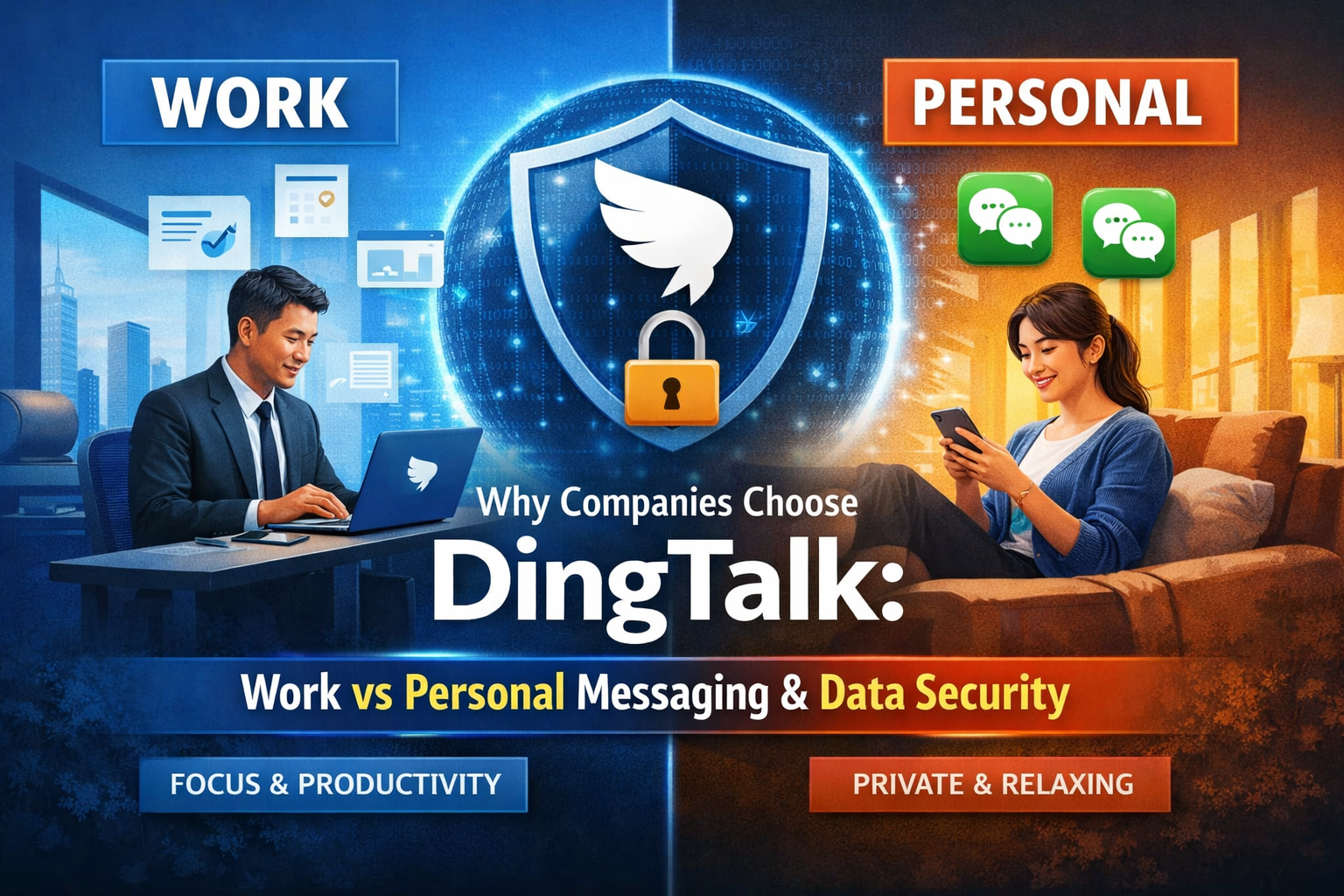
In today’s digital workplace, instant messaging is no longer a support tool—it has become the operational backbone of modern organizations. Decisions are made in chat threads, documents are exchanged through messages, and entire workflows depend on real-time communication. Yet many companies still rely on consumer messaging apps such as WhatsApp or WeChat for internal collaboration. This is where platforms like DingTalk clearly stand apart.
DingTalk is not just another messaging app. It is a dedicated corporate IM and office automation platform designed to help companies separate personal communication from professional work, while giving organizations full control over their data, workflows, and governance.
This distinction is exactly why both employees and employers increasingly prefer DingTalk over consumer messaging tools.
From an employee’s point of view, one of the biggest advantages of using DingTalk is the ability to clearly separate work communication from personal messaging.
Apps like WhatsApp and WeChat were built for social interaction. Family chats, friends’ conversations, community groups, and work messages all live in the same space. Over time, this creates constant interruption and psychological pressure. A work message arriving late at night feels intrusive not because of its content, but because it appears in the same place as personal conversations.
DingTalk changes this dynamic. Work communication stays inside a dedicated professional environment. When employees close DingTalk, they are mentally and practically stepping away from work. This separation helps protect personal time, reduce burnout, and improve focus during working hours.
Ironically, when boundaries are respected, responsiveness improves. Employees are more engaged during work time because communication feels structured rather than invasive.
Modern employees are no longer desk-bound. They attend client meetings, travel, and work remotely. DingTalk allows employees to securely access company conversations, documents, and workflows anytime, anywhere—without relying on scattered chat histories across personal apps.
Unlike WhatsApp or WeChat, where important files are buried under weeks of unrelated messages, DingTalk organizes information by teams, projects, and permissions. Employees can quickly retrieve contracts, presentations, or approval records while meeting clients, without scrolling endlessly through chat threads.
Accessibility becomes intentional and efficient, not chaotic.
From a company’s perspective, the risks of using consumer messaging apps are much more serious.
When business communication happens on WhatsApp or WeChat, company data is effectively stored on employees’ personal devices and private accounts. Contracts, pricing discussions, customer information, and internal strategies are scattered across phones the company does not own or control.
This creates major vulnerabilities. If an employee resigns, loses their phone, or leaves unexpectedly, critical company data may be lost or leaked. In some cases, information may remain permanently outside the organization’s reach.
DingTalk solves this by ensuring that all company data belongs to the company, not the individual. Access rights are centrally managed. When an employee leaves, their access can be revoked immediately, while all data remains safely inside the corporate system.
This is not about surveillance. It is about responsible data governance.
As data privacy regulations tighten globally, companies are increasingly accountable for how information is stored, shared, and protected. Consumer messaging apps were never designed to meet enterprise-level compliance requirements.
Messages can be forwarded without control, files may be backed up automatically to personal cloud accounts, and audit trails are often incomplete or unavailable. These blind spots expose companies to legal and regulatory risks.
DingTalk, as a corporate-grade platform, is built with security, permissions, and auditability in mind. Companies can define who can access specific information, track document usage, and ensure sensitive data does not leave authorized environments.
For industries such as finance, healthcare, education, and professional services, this level of control is no longer optional—it is essential.
Another key reason companies adopt DingTalk is that it goes beyond messaging.
Communication alone does not run a business. Companies need approvals, workflows, attendance tracking, document collaboration, and reporting. DingTalk integrates instant messaging directly with office automation tools, turning conversations into executable processes.
Instead of sending a message asking for approval, employees can initiate structured approval workflows. Instead of emailing documents back and forth, teams collaborate on shared files with clear version control. Managers gain visibility into operations without micromanaging individuals.
This integration transforms communication from passive conversation into an active operational system.
Using DingTalk also reinforces professional culture.
When work communication happens in a dedicated corporate platform, expectations are clearer. Employees understand that discussions are part of official work records. This encourages clearer communication, reduces misunderstandings, and promotes accountability.
At the same time, personal messaging apps remain personal. Employees no longer need to mix emojis, family chats, and sensitive business discussions in the same environment. The result is a healthier, more professional communication culture.
Choosing DingTalk is not simply an IT upgrade. It is a strategic decision about how a company defines work, ownership, and responsibility.
Employees benefit from better work-life boundaries, structured access to information, and reduced communication stress. Employers gain stronger data security, regulatory compliance, and operational efficiency.
In an era where information is one of a company’s most valuable assets, relying on consumer messaging apps for internal operations is no longer sustainable. Platforms like DingTalk are not about control—they are about building a safer, more scalable, and more human way of working.
And that is why more companies are making the shift.
AIX Society applauds the Hong Kong AI Budget 2026, welcoming HK$100M+ in AI investments, an

Customer service is often the difference between a loyal customer and a lost one. Yet

Creating, managing, and sharing documents has always been central to enterprise operations. But in a
此工具使用智譜 AI GLM-ASR-2512 語音識別模型。請輸入您的 API Key:
API Key 只儲存在您的瀏覽器,不會傳送到任何伺服器
使用智譜 AI GLM-ASR-2512 自動生成節目摘要、YouTube 標題與 Hashtag
支援 MP3, WAV, M4A, OGG 格式(最大 20MB)
連接到智譜 AI
等待分析...
等待分析...
點擊標籤可選擇,藍色為已選中
HKOEA Consultancy
Licence No. 59684
© 2025 Artificial Intellegence Application Research Society. All rights reserved
by Originals Group – Hong Kong, Malaysia, GBA