

HKPC Speech: 40% Cost Reduction, 10x Market Growth — The Practical Logic of Expanding AI into Malaysia
HKPC speech by Michael So on expanding AI into Malaysia — covering 40% cost reduction,

Originally published in Chinese on HK01 on 2025-10-10 07:00 | By Michael C.S. So | AiX Society
The rapid development of artificial intelligence in recent years has every industry eager to get involved. Yet for small and medium-sized enterprises (SMEs) in Hong Kong and across Asia, AI adoption often remains a distant concept. The reasons are easy to understand: most of these companies have fewer than fifty employees, lack dedicated IT staff, and cannot afford the high costs of system deployment. Under these circumstances, implementing AI in one leap is nearly impossible. The truly pragmatic approach is to first complete the digitalization and automation of business processes. This is not just about reducing paper and verbal communication — it’s about transforming daily operations into trackable, analyzable, and optimizable data flows. Only when this foundation is in place can AI truly deliver value.
Many SMEs still rely on WhatsApp groups to assign work or handle tasks through verbal instructions. Expense reimbursements require paper forms to be signed level by level, and procurement documents must be hand-delivered for approval. While this approach may seem flexible, it is actually inefficient, error-prone, and lacks any data accumulation. When the boss asks, “How many customer inquiries last month ultimately converted into orders?” the company often needs someone to manually sift through piles of scattered records to cobble together an answer.
This is precisely why digital platforms matter: they move everyday processes to the cloud and generate structured data, giving management real-time visibility into business operations.
In recent years, office automation platforms popular across the Asian market may go by different names, but they generally share several core capabilities:
All employees can engage in real-time conversations and group discussions on a single platform, integrated with documents, calendars, and meetings. Messages are no longer scattered across different applications, and read receipts can be tracked to ensure important notifications are not missed.
Processes like expense reimbursement, procurement, and contract approvals can be digitalized. Once a request is submitted, the system automatically routes it to the relevant managers and records processing times. This automation significantly shortens process cycles and prevents “document bottlenecks.”
Platforms typically offer kanban boards or task card features that transform verbal assignments into trackable tasks with assigned owners and deadlines. Employees can check their to-do lists at any time, avoiding the confusion of “who is responsible for what.”
Contracts, reports, design files, and other documents can be stored in the cloud with support for simultaneous multi-user editing and annotation. This not only reduces version confusion but also facilitates future searching and analysis.
Data generated by workflows is automatically aggregated into reports — for example, sales figures, order processing efficiency, and employee task completion rates. Management can view operational status in real time through dashboards, making decisions based on data rather than intuition.
These features may sound ordinary, but for SMEs, they represent the critical bridge from “paper and word-of-mouth” to “data-driven” operations.
In the past year or two, competition among office platforms has entered a new phase: it’s no longer just about who offers the smoothest communication experience, but who can integrate AI capabilities into daily work more quickly and deeply.
These capabilities are no longer just “nice-to-haves” — they directly determine whether a platform can help SMEs move toward intelligent operations.
Take a retail business as an example:
This data ultimately accumulates as enterprise assets. When AI is further integrated, it can provide predictions and recommendations on this foundation — such as analyzing customer churn risk, forecasting stockout timing, or even automatically generating sales strategies.
For SMEs with limited resources, choosing the right platform is critical. Traditional OA platforms can solve basic collaboration and process issues, but without AI capabilities, businesses will soon hit an “upgrade bottleneck” — processes may be in the cloud, but they still require extensive manual operation and cannot truly unlock AI’s potential.
Conversely, platforms that already have deep AI integration allow businesses to naturally enjoy AI-driven efficiency gains during everyday use, without additional investment or migration. For SMEs, this means they can achieve it all in one go: first complete digitalization, then gradually progress toward intelligent operations.
For SMEs in Hong Kong and across Asia to remain competitive in the AI era, the first step must be process digitalization. But when choosing a platform, they cannot focus only on immediate communication and collaboration convenience — they must also consider long-term AI capabilities. Because what truly helps a business sustain growth is not just replacing paper with digital files, but turning data into decision-making intelligence, transforming tasks into automation, and converting meeting notes into actionable steps.
Therefore, businesses should prioritize platforms with stronger AI-driven capabilities. This not only addresses current operational pain points but also lays the foundation for intelligent operations in the future.
HKPC speech by Michael So on expanding AI into Malaysia — covering 40% cost reduction,

By Michael So I recently held a lunch-and-learn session at the office centered on two
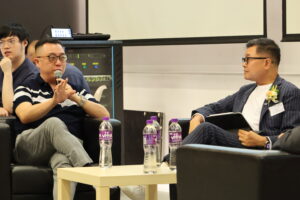
Last Tuesday (June 23), I had the privilege of serving as a panelist at Saint
HKOEA Consultancy
Licence No. 59684
© 2026 Artificial Intellegence Application Research Society. All rights reserved
by Originals Group – Hong Kong, Malaysia, GBA