
OpenClaw 2026.3.12: Dashboard Overhaul + Fast Modes
OpenClaw v2026.3.12 delivers a complete dashboard redesign, GPT-5.4 and Claude fast modes, Kubernetes support, and
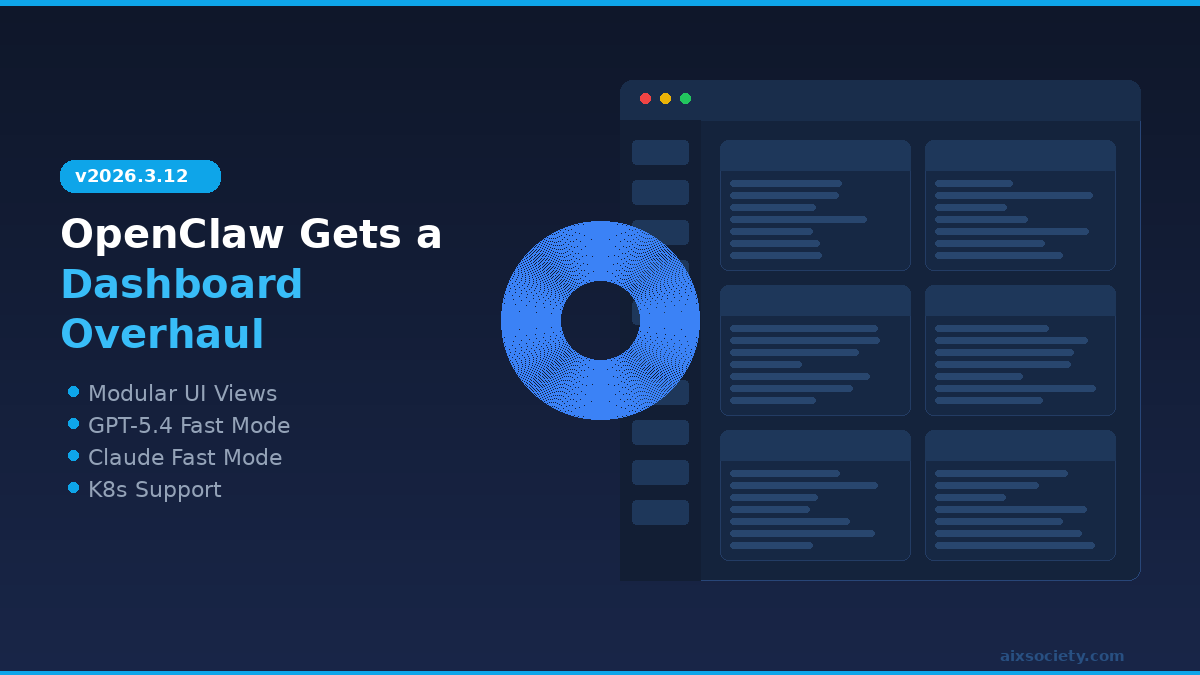
OpenClaw v2026.3.12 brings a long-awaited overhaul of the gateway dashboard, replacing the previous barebones interface with a modular system featuring dedicated views for overview, chat, configuration, agents, and sessions. The update also introduces a command palette, making it faster to navigate between settings and active conversations.
Mobile users benefit significantly from this release. Bottom tabs, slash commands, search, export, and pinned messages are now consolidated in one place instead of being scattered across different screens. As one Reddit user noted, this is “the quality-of-life improvement they’ve been anticipating.”
This release adds configurable fast mode toggles for both OpenAI GPT-5.4 and Anthropic Claude models. Users can now switch between standard and fast processing at the session level using the /fast command, the TUI, Control UI, or ACP. Each model gets per-model defaults and request shaping for optimal performance.
For Claude specifically, the fast toggle maps to Anthropic’s API service_tier parameter with live verification, giving users direct control over response speed versus depth.
Teams running OpenClaw at scale now have official Kubernetes deployment documentation, including starter manifests, Kind setup for local testing, and production deployment guides. This is a significant step toward enterprise adoption, making it easier to run OpenClaw across distributed infrastructure.
Following the recent security concerns raised by Chinese authorities, v2026.3.12 includes multiple security fixes:
The full release notes also include Ollama, vLLM, and SGLang being moved to a provider-plugin architecture for more modular onboarding, a new sessions_yield feature for multi-agent orchestrators, and Slack Block Kit support for richer agent messages.
With rapid-fire releases continuing at a pace of roughly one every two days, OpenClaw’s development momentum shows no signs of slowing. The dashboard redesign in particular addresses one of the most common community complaints and signals a maturing focus on user experience alongside raw capability.
OpenClaw v2026.3.12 delivers a complete dashboard redesign, GPT-5.4 and Claude fast modes, Kubernetes support, and

Chinese government agencies warn staff against installing OpenClaw AI on work devices, citing security risks

OpenClaw v2026.3.8 adds backup/verify commands, provenance receipts, and web search improvements for safer daily agent
HKOEA Consultancy
Licence No. 59684
© 2025 Artificial Intellegence Application Research Society. All rights reserved
by Originals Group – Hong Kong, Malaysia, GBA