

HKPC Speech: 40% Cost Reduction, 10x Market Growth — The Practical Logic of Expanding AI into Malaysia
HKPC speech by Michael So on expanding AI into Malaysia — covering 40% cost reduction,
Originally published in Chinese on HK01 on 2025-11-25 11:50 | By Michael C.S. So | AiX Society
At a time when artificial intelligence technology is advancing at breakneck speed, computing infrastructure, intellectual property protection, and open-source sharing have become focal issues in the innovation landscape. Recently, in my capacity as a member of the Patent Advisory Committee at Hong Kong Baptist University, I attended Huawei’s 2025 Innovation and Intellectual Property Forum held in Beijing, experiencing firsthand this collision of ideas themed “Openness Drives Innovation.” At the forum, Huawei announced the results of its sixth “Top Ten Inventions” selection, spanning key future-oriented technology domains including computing, operating systems, and storage. The most notable among them was the top-ranked “Scale-up Ultra-Large-Scale Supernode Computing Platform” — a supercomputing system hailed as the new infrastructure of the AI era. This article draws on observations from the forum and my practical experience to examine the infrastructural role of this super-computing platform in the AI age, explore the dual significance of “open-source sharing” and “intellectual property” for innovation, and reflect on Hong Kong’s bottlenecks and potential pathways in innovation infrastructure, industry-academia-research translation, and patent culture.
The Scale-up Ultra-Large-Scale Supernode Computing Platform, ranked first among Huawei’s annual Top Ten Inventions, is essentially a single logical supercomputer composed of numerous AI processors. As AI model sizes grow exponentially, the computing power and data throughput required to train these models have surged explosively. When facing ultra-large AI tasks, the traditional approach of stacking servers often encounters the predicament of “the larger the cluster, the lower the effective computing utilization rate, and the more frequent the training interruptions.” Huawei addressed this pain point by innovating a “supernode” system architecture featuring resource pooling, linear scalability, and high reliability. Through unified high-speed protocols and shared memory addressing, it bridges computing and storage units with high-bandwidth, low-latency interconnections, enabling effective computing power to scale nearly linearly with the number of nodes while dramatically improving cluster stability. Huawei’s Rotating Chairman Xu Zhijun emphasized: “Computing power is — and will continue to be — the key to AI.” Based on this consensus, Huawei launched a new generation of Atlas series supernode products, with the Atlas 950 SuperPod corresponding to this Scale-up super-computing platform. Designed for ultra-large-scale AI training tasks, the platform achieves system-level innovation from foundational components and protocol algorithms to opto-electrical interconnections. For example, it employs an orthogonal architecture design to achieve zero-cable electrical interconnection, paired with full liquid cooling and floating blind-mate technology to ensure leak-free operation. It also pioneers the UB-Mesh recursive direct-connect topology, supporting full NPU interconnection within boards, between boards, and across racks. Using 64-card modules for flexible expansion, it can support up to 8,192 Ascend AI processors in a non-blocking interconnect. In other words, thousands of AI chips can converge into “one brain” for collaborative computing, truly eliminating the bottlenecks of ultra-large-scale training.
From a practical standpoint, super computing has moved beyond the laboratory concept to become the foundational bedrock of the industrial AI ecosystem. Huawei revealed that its previous-generation Atlas 900 series supernode systems have been deployed in over 300 installations to date, serving more than 20 clients across industries including internet, finance, telecommunications, power, and manufacturing. In the AI era, local intelligent computing hubs like the Atlas 950 are equivalent to the highways and power grids of the digital economy: providing shared computing resources for the industrial ecosystem, lowering the barriers to deploying innovative applications, and robustly supporting AI solutions from cloud services to vertical industry implementation. For China in particular, against the backdrop of restricted access to advanced chips, Huawei has chosen to leverage existing process technologies to develop ultra-large-scale computing platforms in-house, using systems engineering breakthroughs to compensate for chip performance limitations — demonstrating strategic resolve in laying out long-term AI development with an infrastructure mindset.
This year’s forum conveyed a clear message: open-source collaboration and intellectual property protection are not opposed to each other, but rather twin engines of innovation that must advance in tandem with institutional coordination. Huawei’s Chief Legal Officer Song Liuping stated at the event: “Open innovation is a vital force driving social development and technological progress, and it is part of Huawei’s DNA. Huawei has always practiced the philosophy of ‘openness,’ using openness to drive innovation. At the same time, Huawei values the protection of its own intellectual property and respects the intellectual property of others, including patents, trademarks, copyrights, and trade secrets.” In short, on one hand actively participating in open source and sharing, and on the other strictly safeguarding intellectual property — the two paths run in parallel without contradiction. In recent years, Huawei has spared no effort in patent R&D and strategic positioning. In 2024, Huawei’s patent licensing revenue was approximately $630 million USD, while its cumulative patent licensing fees paid over the years were three times its own licensing income. According to the World Intellectual Property Organization, Huawei published 6,600 international patent applications through the PCT in 2024, ranking first globally since 2014. In 2024 alone, Huawei newly published 37,000 patents, setting a historic record. This formidable patent portfolio has enabled Huawei to build an extensive licensing ecosystem in areas such as 5G, Wi-Fi, and video coding: by the end of 2024, over 2.7 billion 5G devices, 1.2 billion consumer electronics devices, and 3.2 billion multimedia devices worldwide had been licensed under Huawei patents, with 48 of the Fortune Global 500 companies directly or indirectly holding Huawei license agreements.
On the other hand, Huawei has invested equally significant resources in open source and openness. Its Vice President and Head of the Intellectual Property Department, Fan Zhiyong, noted that Huawei promotes technological openness through “multiple forms including software open source, hardware openness, patent applications, standards contributions, and academic papers.” In 2024, Huawei submitted over 10,000 new technical proposals to standards organizations and published more than 1,000 academic papers. In the open-source community, it has led or participated in numerous large-scale projects — for instance, the OpenHarmony open-source operating system community now has over 8,100 contributors; the openEuler open-source OS distribution has surpassed 10 million cumulative installations; and Huawei has fully open-sourced its Ascend AI foundational software stack, including the CANN computing architecture and the MindSpore deep learning framework, with priority adaptation for mainstream open-source communities such as PyTorch and vLLM.
This demonstrates that “intellectual property protection” safeguards innovators’ return on investment and commercial motivation, while “open-source sharing” pools collective wisdom to accelerate technological maturity and application diffusion. The two are not incompatible — the key lies in finding institutional balance and synergy. As Professor Deng Xihui of the University of Hong Kong noted, a robust, open, and internationally trusted patent system is an indispensable condition for the innovation engine to function.
Globally, the contest between “open source” and “closed source” continues to evolve. NVIDIA has built a closed ecosystem around its CUDA software platform, creating exceptionally high market barriers and a profit cycle. Meanwhile, OpenAI’s transition from open source to closed source has also prompted reflection. When companies like Meta rose to prominence with open-source models like Llama, the open-source ecosystem once again demonstrated its powerful vitality. These cases collectively illustrate that only by balancing patent protection with open-source collaboration can technological innovation continue to evolve amid both competition and shared prosperity.
What I witnessed at the Huawei forum inevitably drew my thoughts to Hong Kong’s own innovation development situation. Hong Kong’s R&D investment has been chronically low — in 2023, local R&D expenditure accounted for only 1.11% of GDP, far below that of major economies. Universities shoulder more than half of R&D spending, while insufficient investment from enterprises and the government leads to low rates of research commercialization. Many professors head north to Shenzhen in search of funding, highlighting how institutional and environmental constraints limit local innovation potential. Furthermore, Hong Kong’s long-standing deindustrialization has left manufacturing at less than 1% of its economy, lacking a hard-tech industrial chain, with prohibitively high startup costs. Patent culture has yet to take root, and SMEs have limited understanding of intellectual property. Research evaluation prioritizes publications over commercialization, and insufficient incentives for technology transfer leave a great deal of research output “sitting in laboratories.”
I believe Hong Kong should pursue breakthroughs in the following directions:
In conclusion, if Hong Kong is to redefine its position amid the AI wave, it must build an institutional environment that is both open and orderly, one that encourages innovation while safeguarding rights. Open source and intellectual property are not adversaries but the twin engines of innovation in the AI era. Only by making both work in concert can Hong Kong find its own rhythm in the global technology race and forge a path toward its own smart economy.
HKPC speech by Michael So on expanding AI into Malaysia — covering 40% cost reduction,
By Michael So I recently held a lunch-and-learn session at the office centered on two
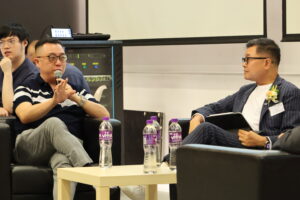
Last Tuesday (June 23), I had the privilege of serving as a panelist at Saint
HKOEA Consultancy
Licence No. 59684
© 2026 Artificial Intellegence Application Research Society. All rights reserved
by Originals Group – Hong Kong, Malaysia, GBA