
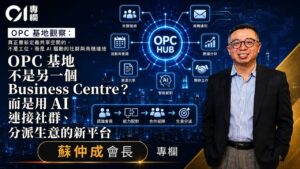
The Rise of OPC Hubs: What Is Truly New When They Are Just Business Centres?
By Michael C.S. So | AiX Society My first reaction was, quite bluntly: What exactly

For decades, Hong Kong has been a city that prefers imports — not only in goods, but in software. Microsoft, Google, Adobe, Salesforce — these names dominate the screens of government offices, corporations, and classrooms. For many, “international standard” has long meant “Made in America.” Yet this comfortable assumption is being quietly rewritten by geopolitics, data regulation, and the region’s accelerating economic integration.
By 2026, China will roll out a new wave of data security and cross-border data regulations. Data flows within the Greater Bay Area (GBA) will be governed by standardized contracts and filing mechanisms. At the same time, the global technology supply chain is fracturing under the weight of sanctions and export controls. Hong Kong now finds itself straddling two digital worlds: one defined by the cloud empires of the U.S. and Europe, and the other by the maturing software ecosystem of mainland China.
The question is no longer “which is more user-friendly,” but “which is safer, more sustainable, and better aligned with Hong Kong’s future.”
Hong Kong’s digital infrastructure was largely shaped during two decades of globalization — an era that believed “the cloud has no borders.” From accounting to education, from customer service to design, most systems were owned and operated by overseas providers.
But the cloud has always had borders — they were simply hidden in code and contracts.
The U.S. CLOUD Act allows Washington to demand access to data stored abroad by American companies. The EU’s GDPR tightly restricts cross-border data transfers. China’s Data Security Law and Personal Information Protection Law have drawn their own red lines. Caught between these legal regimes, Hong Kong’s previous ability to operate “comfortably in both worlds” is rapidly fading.
Imagine a Hong Kong financial firm whose core systems run on U.S.-based cloud infrastructure. If Washington–Beijing tensions were to escalate tomorrow, could export control measures suddenly cut off access? Could technical support be restricted under new policy rules?
These are not hypothetical scenarios. The precedents set by Huawei, ZTE, and TikTok show how swiftly politics can spill into code.
Software is now critical infrastructure. And when a city’s infrastructure depends overwhelmingly on one geopolitical bloc, it effectively hands over the power switch.
Hong Kong once built prosperity on ports and power grids; today it must think just as seriously about its information supply chains.
For years, Hong Kong users dismissed mainland software as “not international enough.” That laughter is beginning to sound nervous. Alibaba, Tencent, Huawei, and ByteDance have built comprehensive cloud ecosystems. Thousands of smaller Chinese developers are creating enterprise solutions — from collaboration platforms and AI analytics to secure e-government systems.
These programs have three key features: they comply with Chinese law, they compete aggressively on cost and service, and they are built with local linguistic and operational contexts in mind.
More importantly, many can operate entirely within China’s data borders — without routing through foreign servers. For businesses serving both Hong Kong and cities like Shenzhen or Guangzhou, this “geographic compatibility” is a practical strength, not a political statement.
The GBA’s new data transfer framework is also taking shape. The Greater Bay Area Standard Contract introduced in 2024 allows companies to exchange personal information legally through a filing system. Using software developed within the Chinese regulatory environment can significantly reduce compliance costs.
In other words, choosing Chinese-made software isn’t just about security — it’s about efficiency and regulatory alignment.
Every mature economy must beware of replacing one dependency with another.
Mainland software may reduce geopolitical exposure to the West, but if Hong Kong simply trades one monopoly for another, the underlying fragility remains.
Some Chinese developers still struggle with code transparency, open standards, and version stability. Adopting them wholesale could introduce new maintenance and interoperability risks.
The smarter strategy is hybrid: coexistence, not replacement.
Use both international and Chinese software ecosystems to diversify exposure while maintaining global connectivity.
Wisdom, in this case, lies not in exclusion but in compatibility.
For many organizations, shifting to Chinese-developed systems means retraining staff, rewriting workflows, and reconfiguring servers. The short-term costs are tangible. But long term, this is an insurance policy for data sovereignty.
When core systems, data, and maintenance teams can reside partly within local or GBA jurisdictions, companies gain bargaining power and resilience.
Unexpectedly, this shift could also stimulate Hong Kong’s underdeveloped tech industry.
The city’s innovation ecosystem has long leaned toward application, not production. A rising demand for “China-compatible” systems could spur local start-ups to specialize in security auditing, systems integration, and cross-border data compliance — turning “innovation and technology” from slogan into sector.
The Hong Kong government’s role in this transition is pivotal.
If public institutions continue to treat foreign software as the default option in procurement, market inertia will persist. But if future tenders explicitly require “GBA compatibility” or a certain percentage of local development, a clear signal will be sent — encouraging a more balanced, multi-source supply chain.
The government should also help businesses navigate compliance. Establish a one-stop mechanism for cross-border data assessments. Promote mutual recognition between Hong Kong’s data protection frameworks and mainland cybersecurity certifications. Encourage universities to train professionals in “data sovereignty and cyber law.”
In the digital age, a city’s governance of data is as crucial to its financial center status as its legal system once was.
At first glance, this may seem a matter of brand preference. In truth, it’s a matter of institutional trust.
To use an American cloud service is to trust the U.S. legal system; to use a Chinese platform is to trust China’s data governance.
Hong Kong’s balancing act between the two cannot be solved by diplomacy alone — it requires engineering and governance, a kind of technological Confucianism rooted in pragmatism.
In practice, no serious company will rely exclusively on one side.
The emerging model will be dual-track:
core and sensitive operations hosted on local or mainland platforms for compliance and security, while non-sensitive global operations continue on international services for efficiency and reach.
Like urban transport, resilience comes from variety — you need both the MTR and the taxi.
As China’s new data rules take effect in 2026, Hong Kong firms will face a reckoning.
Any business that handles mainland customer data or relies on cross-border cloud services will need to map data flows with forensic precision.
By then, debating whether to switch software may be too late.
Executives who still think this is an “IT department problem” misunderstand the age they live in.
In a world run by algorithms, information systems are the nervous system of a company.
Data sovereignty is corporate sovereignty.
Hong Kong built its reputation on agility and neutrality. But true competitiveness lies not in merely surviving between powers — it lies in inventing new frameworks.
In this software realignment, the city could create a “bilingual” technological identity: fluent in international open standards, but equally literate in China’s regulatory and security lexicon.
Such a Hong Kong would no longer be just a mediator between two systems, but a creator of its own hybrid model.
As Silicon Valley’s clouds drift farther away, the algorithms across the Pearl River are rising fast.
The next question is not whose interface looks sleeker — but whose infrastructure better fits the geopolitical and regulatory weather of the decade ahead.
For Hong Kong, this is more than a software update. It is a reprogramming of its institutional DNA.
By Michael C.S. So | AiX Society My first reaction was, quite bluntly: What exactly

By Michael C.S. So | AiX Society Just how much information does a company generate

Recently, I have been recruiting, and what I am looking for is not just someone
HKOEA Consultancy
Licence No. 59684
© 2026 Artificial Intellegence Application Research Society. All rights reserved
by Originals Group – Hong Kong, Malaysia, GBA