
From Interview to Intelligence: How DingTalk A1 Turns Staff Interviews into Structured Decisions with AI Tables
Hiring and internal staff interviews are deceptively expensive processes. Not because of salary costs, but
Hiring and internal staff interviews are deceptively expensive processes. Not because of salary costs, but because of information leakage. Insights are spoken, not captured; judgments are made, not structured; decisions are remembered, not auditable. The result is familiar: fragmented notes, inconsistent evaluations, and bias hidden inside human memory.
This is precisely where DingTalk A1, when combined with AI Tables and customizable AI agents, changes the nature of interviews altogether. Instead of interviews being ephemeral conversations, they become structured organizational intelligence.
To understand how this works in practice, let’s walk through a realistic staff interview scenario, step by step.
In a typical organization, a staff interview looks like this:
This workflow has three structural weaknesses:
First, unstructured input. Spoken answers are rich but chaotic. Different interviewers remember different things.
Second, non-standard evaluation. Even with a scoring sheet, interpretations vary wildly.
Third, no data continuity. Interviews don’t easily connect to hiring analytics, onboarding plans, or performance tracking.
DingTalk A1 + AI Tables addresses all three — not by “automating HR,” but by structuring human judgment.
Imagine an internal interview for a senior operations manager role.
The interviewer places the DingTalk A1 device on the table or clips it to a badge. From this moment:
Crucially, A1 is not just “recording audio.” It is producing high-quality, timestamped, machine-readable text, already integrated inside DingTalk.
This matters because AI cannot reason well over raw audio. It reasons over structured language.
At the end of the interview, the transcript is already available in DingTalk — no uploading, no manual handling, no file chaos.
This is where the system becomes interesting.
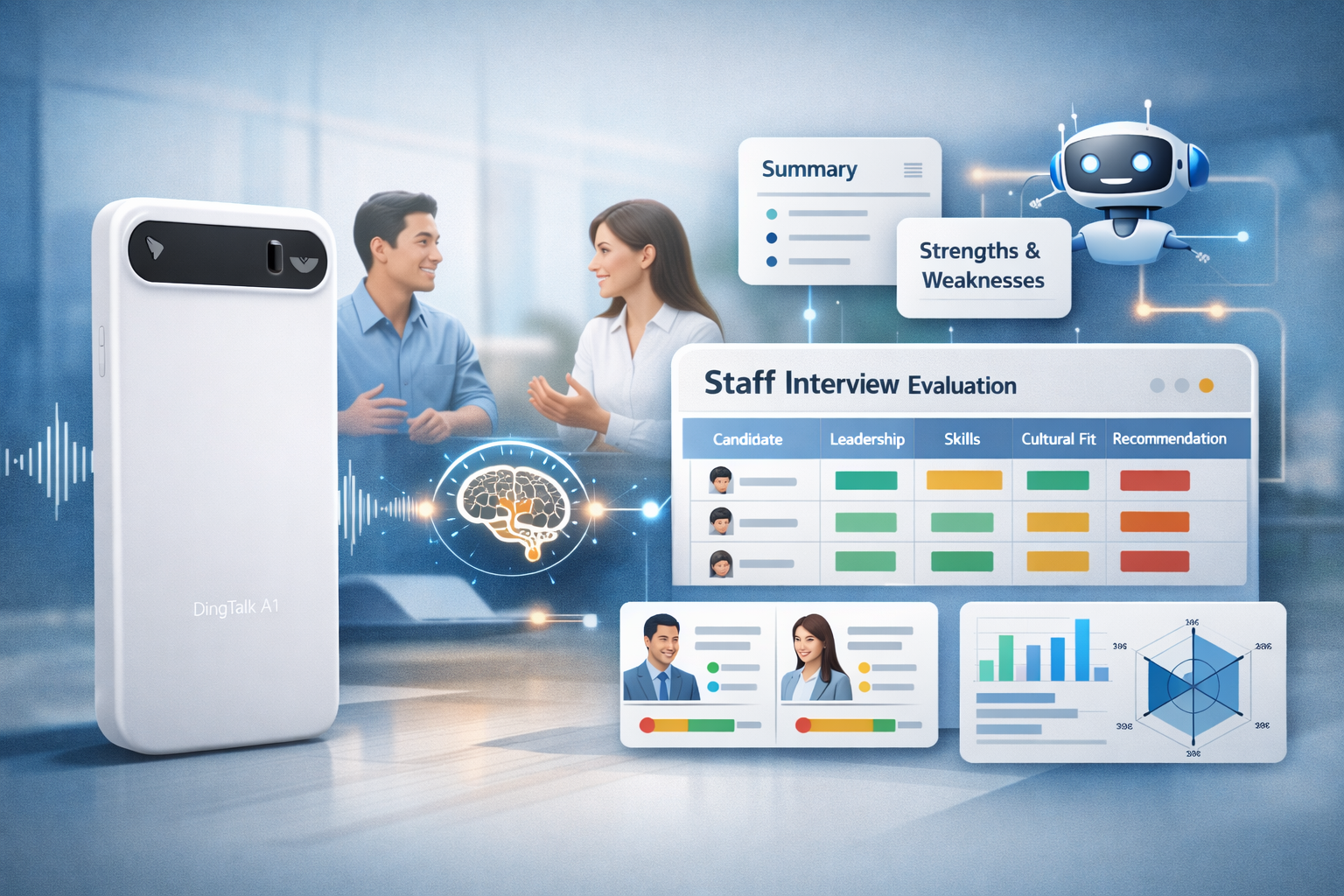
Instead of staring at a long transcript, the interviewer selects a Staff Interview AI Table Template. This template is not a static spreadsheet. It is a semantic framework that tells the AI what to extract and how to organize it.
A typical staff interview AI table may include columns such as:
Once the template is applied, the AI reads the entire interview transcript and begins mapping spoken content into structured rows and fields.
For example:
When the candidate says:
“In my last role, I rebuilt the supply workflow because reporting was broken and teams didn’t trust the numbers.”
The AI does not simply copy the sentence. It interprets it as:
That interpretation is then stored inside the AI table, not as prose, but as structured, queryable data.
Most AI summaries are shallow. They paraphrase.
This system does something different.
Using the interview template, the AI generates multiple layers of summary:
All of this is derived directly from the AI table — meaning the summary is explainable. Decision makers can click back to the original transcript segments that generated each judgment.
This is a subtle but powerful shift: the summary is no longer an opinion. It is a traceable synthesis.
Now we move beyond documentation into decision support.
The organization has configured a custom HR interview AI agent inside DingTalk. This agent has a defined role:
“Evaluate staff interviews for operational leadership roles, based on our internal competency model.”
This agent does not invent standards. It uses:
Once the interview table is completed, the AI agent performs several actions automatically:
For example, if the candidate claims strong leadership but provides few concrete examples, the agent may suggest:
“Ask for a specific incident involving team conflict resolution with measurable outcomes.”
This turns the second interview into a targeted probe, not a vague repeat.
One of the most underappreciated advantages of AI tables is comparative intelligence.
After interviewing five candidates, HR can place all interview tables side by side. Because the structure is consistent, the AI can now answer questions like:
These are questions that humans think they answer intuitively — but often don’t.
The AI agent can generate a comparison report grounded in structured interview data, not gut feeling.
This does not replace human judgment. It disciplines it.
Here is where DingTalk’s approach quietly outperforms traditional HR tools.
Once a candidate is hired, the same AI table does not disappear.
It becomes:
For instance, if the interview highlighted strong strategic thinking but weaker system execution, onboarding tasks can be aligned accordingly. The AI agent can later ask:
“Has the initial execution gap improved in the first 90 days?”
This closes the loop between what a candidate said, why they were hired, and how they actually perform.
The significance of DingTalk A1 + AI Tables in staff interviews is not speed. It is organizational memory.
Traditional interviews create opinions. This system creates institutional knowledge.
It reduces bias by making evaluation criteria explicit.
It improves consistency by enforcing structure.
It increases accountability by making decisions traceable.
Most importantly, it transforms interviews from isolated conversations into data assets that inform hiring strategy, leadership development, and workforce planning.
It is important to be precise: this is not about letting AI “decide who to hire.”
It is about augmenting human judgment with structured intelligence.
Humans remain responsible for values, ethics, and final decisions. AI ensures that those decisions are made with clarity, evidence, and consistency.
DingTalk A1 is simply the entry point — the device that ensures nothing valuable is lost at the moment it is spoken.
Staff interviews are just one example.
The same architecture applies to:
Any process where people talk, decisions matter, and memory fails is a candidate for this model.
What DingTalk is quietly building is not a recorder, not a table, not an agent — but a system where conversation becomes computation.
And once conversations can be computed, organizations stop guessing — and start learning.
Hiring and internal staff interviews are deceptively expensive processes. Not because of salary costs, but
In the modern enterprise, the friction isn’t just in doing the work — it’s in

In today’s digital workplace, instant messaging is no longer a support tool—it has become the
HKOEA Consultancy
Licence No. 59684
© 2025 Artificial Intellegence Application Research Society. All rights reserved
by Originals Group – Hong Kong, Malaysia, GBA