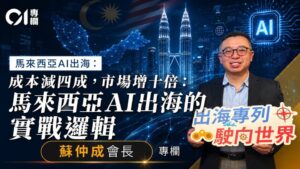
HKPC Speech: 40% Cost Reduction, 10x Market Growth — The Practical Logic of Expanding AI into Malaysia
HKPC speech by Michael So on expanding AI into Malaysia — covering 40% cost reduction,

Originally published in Chinese on HK01 on 2025-12-03 12:09 | By Michael C.S. So | AiX Society
Ant Group recently launched its next-generation artificial intelligence system, Lingguang AI, which allows users to automatically generate a functional mini application — called a Flash App — in approximately 30 seconds, simply by typing a single natural language instruction. Since its release, the technology has rapidly drawn attention across mainland China and is being hailed as a major milestone in the shift toward “No-Code” software development.
Lingguang AI features multimodal capabilities, meaning it can simultaneously understand text, images, and camera feeds. Users need only type descriptions like “build me an expense calculator” or “create a workout tracker,” and the system will automatically generate the interface, functional logic, and basic interactions — no programming background required. Ant Group has stated that through this product, it hopes to enable more people to create their own practical tools, turning “anyone can build an app” into reality. For this feature, we invited Michael So, Founding President of the AI Application Research Society (AiX Society), to share his insights.
During a demonstration observed by reporters, after a user inputs a request, Lingguang AI rapidly generates an interface complete with buttons, fields, lists, or calculation logic — ready for immediate use. The system also allows users to modify input rules, adjust the appearance, or add additional elements to better suit their actual needs.
Ant Group emphasized that Lingguang AI is not a traditional template-based mini program. Instead, it uses a large language model to understand user intent and then automatically assembles the required functions, making the creation process far more intuitive. A smartphone thus becomes an instant “software creation platform” — no need to download development tools or understand programming syntax.
Many users have reported that Lingguang AI allows them to turn ideas in their heads into working software, no longer held back by “not knowing how to code.” Market observers have also suggested that tools like this could accelerate the expansion of the creative ecosystem, driving the emergence of more personalized and niche applications.
Commenting on this trending topic, Michael So, Founding President of the AI Application Research Society (AiX Society), told HK01 reporters that the greatest significance of Lingguang AI is that it frees creativity from the constraints of technical ability.
So noted: “Many people have always been creative — they just couldn’t bring their ideas to life because they didn’t know how to code. Technologies like Lingguang AI mean that creation no longer requires engineering knowledge. You can turn an idea into software at your fingertips.” He described how tools like this will bring people from all walks of life into the creative fold — including frontline workers, students, retail staff, insurance agents, and even the elderly — because all they need to do is describe what they want to build a prototype. The output of mini tools will inevitably multiply.
So added: “In the past, engineers translated other people’s ideas into code. Now, everyone can bring their own ideas to life. Once the barrier to creation drops, we’ll actually see brand-new tools that never existed before.” He believes this will make the creative ecosystem far more vibrant — no longer dominated solely by professional engineering teams, but instead allowing creativity to flow rapidly across every industry.
As Lingguang AI showcases its ability to generate apps from natural language, some have worried that software engineers’ jobs will be replaced. So believes this view does not reflect reality. He emphasized: “Engineers will not lose their jobs — absolutely not. In fact, they’ll be needed more than ever.” When a large number of creators can produce their own mini tools, the entire software ecosystem will become larger and more complex. Integration between systems, data flows, and performance demands will all increase, making the engineer’s role even more critical.
So explained: “AI can build simple apps, but truly large-scale systems, enterprise-grade applications, and cross-platform integrations still require engineers. The software architecture of the future will only become more refined, not simpler.” He noted that engineers’ future responsibilities will include overseeing AI-generated workflows, refining system architecture, and ensuring system stability: “AI can help write code, but engineers need to be responsible for managing how AI writes code. This is an upgrade, not a replacement.”
Looking ahead, So envisions the emergence of many new software-related roles, including “AI Generation Supervisors,” “Model Gap Engineers,” and “Enterprise Integration Architects” — all new professional fields born from the widespread adoption of AI.
In summary, So noted that as natural language app generation technology continues to mature, we will see more and more people transforming everyday scenarios, workflows, and personal interests into real software through AI tools like this.
“Creation will shift from being the ability of the few to an action available to everyone. Whatever you can imagine, you can instantly build.”
HKPC speech by Michael So on expanding AI into Malaysia — covering 40% cost reduction,
By Michael So I recently held a lunch-and-learn session at the office centered on two
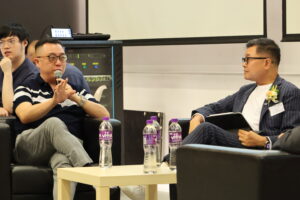
Last Tuesday (June 23), I had the privilege of serving as a panelist at Saint
HKOEA Consultancy
Licence No. 59684
© 2026 Artificial Intellegence Application Research Society. All rights reserved
by Originals Group – Hong Kong, Malaysia, GBA