
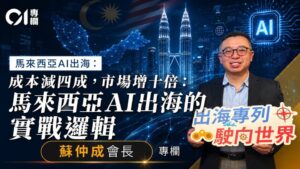
HKPC Speech: 40% Cost Reduction, 10x Market Growth — The Practical Logic of Expanding AI into Malaysia
HKPC speech by Michael So on expanding AI into Malaysia — covering 40% cost reduction,
Originally published in Chinese on HK01 on 2025-11-10 08:00 | By Michael C.S. So | AiX Society
Recently, I began expanding our AI Transformation consulting business and preparing to hire several new employees. This process gave me a profound realization: future team management isn’t just about finding the right people — it’s about understanding how to make humans and AI work together. In our case, we need to consider not only whether employees can operate AI, but whether they have the ability to design AI workflows, are willing to build SOPs, and know how to collaborate with AI using data and logic. This is precisely why I wrote this article.
Adopting AI in an enterprise isn’t just about saving headcount — it’s a “magic mirror” for your entire management system. Teams without clear processes will only become more chaotic after introducing AI, because what AI excels at is amplifying the outcomes of human behavior — the good gets better, and the bad gets worse.
I often remind management: AI doesn’t “solve your chaos” — it helps you see where the problems are, faster. If a team lacks clear responsibilities, data records, or decision-making transparency, AI will mercilessly expose every one of those gaps.
Today’s hiring is no longer just about asking “Do you know AI?” It’s about: “Are you willing to let AI help you work?”
In my consulting experience, employees who can truly collaborate with AI share three traits:
AI-ready talent doesn’t have to be programmers — they are people who can think logically and articulate processes clearly. These individuals will drive increasing automation in your company and ensure that team knowledge no longer resides solely in individual heads.
In the AI era, hard work alone is no longer a core competitive advantage. What truly matters is: “Can you design a system that lets AI do more for you?”
Therefore, performance evaluation must also transform. Traditional companies measure “output volume”; future companies will measure “systematization capability.”
For example:
These new metrics will become the new management language of the AI era.
Designing AI workflows cannot be left solely to the tech department. The people who understand the business best should be at the core of the design process.
From my enterprise consulting work, I’ve distilled four steps:
My principle is: “AI creates the first draft; humans are responsible for the final review.” Once AI is properly trained, humans can focus on strategy, creativity, and decision-making.
It’s common for a company to use multiple AI tools simultaneously, but problems follow: scattered data, unclear permissions, and redundant operations.
Therefore, we must build an “AI hybrid management system” that gives different AI tools clearly defined roles, data flows, and task logic. Simply put, you need to manage not just people, but your “AI team” — a group of invisible yet constantly working virtual employees.
This is the new challenge for future managers: AI Governance.
I’ve encountered many employees across companies who become anxious the moment they hear “AI.” They worry about being replaced, but the truth is: AI doesn’t replace people — it replaces those who refuse to learn.
AI amplifies your strengths, but it also amplifies your complacency. True security comes not from avoidance, but from learning to use it.
Management’s role is to create a culture that “permits trial and error,” where employees feel safe to experiment and gradually build confidence. When AI becomes part of the job, people can focus on creating value.
AI can make work faster, but it cannot make work more meaningful. The soul of an enterprise still lies in those who are willing to think and willing to optimize processes.
AI-human hybrid management is an upgrade in corporate culture: from “How do I do this?” to “How do I design a system to do this?”
This is not just a technological revolution — it is a transformation in management philosophy. For me, AI will not replace people — it simply enables those who are prepared to go further and faster.
HKPC speech by Michael So on expanding AI into Malaysia — covering 40% cost reduction,

By Michael So I recently held a lunch-and-learn session at the office centered on two
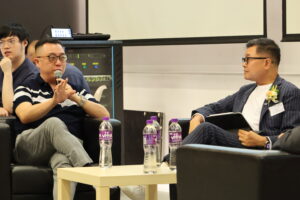
Last Tuesday (June 23), I had the privilege of serving as a panelist at Saint
HKOEA Consultancy
Licence No. 59684
© 2026 Artificial Intellegence Application Research Society. All rights reserved
by Originals Group – Hong Kong, Malaysia, GBA