HKPC Speech: 40% Cost Reduction, 10x Market Growth — The Practical Logic of Expanding AI into Malaysia
HKPC speech by Michael So on expanding AI into Malaysia — covering 40% cost reduction,
Originally published in Chinese on HK01 on 2025-11-15 08:00 | By Michael C.S. So | AiX Society
As the wave of artificial intelligence (AI) sweeps across workplaces worldwide, we face the most profound transformation in work patterns and organizational structure since the Industrial Revolution. From the rise of Generative AI to the maturing concept of AI Agents, technology is reshaping how businesses operate at unprecedented speed. Efficiency is no longer a scarce resource that companies chase — it has become a “standard feature,” as basic as water and electricity. But when machines can do things faster and more accurately, where does a leader’s true value lie? How has this digital revolution, waged in the name of efficiency, affected the invisible “Psychological Contract” and the core sense of “trust” between companies and their employees?
From my firsthand experience driving team members to adopt AI-powered office automation (OA) systems like DingTalk and Teams, I’ve come to deeply appreciate the core challenge of this transformation: technology is only a small part of it. The far greater challenge is executing people-centered Change Management.
Traditionally, we categorized the “Psychological Contract” into two types: the “transactional contract” based on salary and working hours, and the “relational contract” built on social-emotional bonds, emphasizing long-term collaboration and trust. Research shows that before AI entered the picture, relational contracts significantly boosted employee engagement and trust in the company.
However, with the introduction of AI, this positive effect has notably diminished. AI doesn’t just change how tasks are executed — it can trigger a new type of relational mutation: the “Alienational Contract.” When work is comprehensively managed by AI technology and interpersonal communication is drastically reduced, the relationship between employees and the company becomes superficial. Employees may feel alienated and anxious, leading to declining productivity.
Employee concerns are real and multidimensional. First, there is job insecurity — particularly for lower-skilled roles, AI creates uncertainty about the future. Second, trust weakens — when AI becomes the primary controlling force, employees’ trust in the company is significantly undermined. Our research confirmed this massive trust gap: 58% of employees worry about job security (their positions being replaced), yet less than a third of executives (29%) are aware of this concern. Furthermore, 60% of employees worry that AI may increase workplace stress and burnout, but only 37% of business leaders recognize this issue.
This pervasive anxiety and uncertainty means that even when AI technology itself is excellent, its integration into workflows can fail due to poor Change Management. McKinsey’s research points out that the biggest barrier to scaling AI adoption is not employee unpreparedness, but rather leaders who move too slowly in driving transformation and underestimate employees’ awareness of and desire for AI. In fact, the vast majority of employees (95%) believe that applying Generative AI at work would be highly beneficial.
In the AI era, efficiency is table stakes. A leader’s core mission has therefore shifted from “completing tasks” to “uniting hearts” — building connections, understanding, and support between people. Flora Chen, former Chief Operating Officer of Microsoft Taiwan, proposed that leaders must shift from a “Know-it-all” mindset to a “Learn-it-all” mindset. The value of leadership lies in the ability to provide emotionally driven engagement that resonates on a human level.
This requires leaders to redefine their role — transforming from traditional controllers into enablers and coaches. When AI can handle processes and data, leaders should employ the core skill of Coaching Leadership: asking the right questions rather than providing standard answers. This shift helps team members explore more possibilities and become more willing to share innovative ideas.
I personally experienced the enormous challenge of driving partners to adopt an AI OA system. This was a textbook case of organizational change, perfectly illustrating the journey from pursuing efficiency to rebuilding trust.
Initially, our focus was entirely on efficiency. The AI system promised to automate repetitive tasks such as report generation, data analysis, and cross-departmental scheduling. We expected our partners to operate at unprecedented speed, like machines. However, as described in the “Unfreeze” stage of change management models, when old processes are challenged, partners quickly entered a phase of resistance.
Resistance first manifested as distrust of the system and low adoption rates. I discovered that some senior partners, while appearing to use the new system on the surface, were privately still relying on traditional email or legacy spreadsheets — classic “low adoption” and “covert resistance.” They weren’t just resisting the technology itself; they feared AI would replace the experience and judgment they had accumulated over many years.
This anxiety led to the emergence of the “Alienational Contract” phenomenon. Partners asked: “If AI can write reports faster than I can, what’s my value?” They felt marginalized, believing the company only cared about the performance gains AI delivered while ignoring their contributions as individuals. In Bridges’ Transition Model, they were in the “Ending” stage, experiencing a sense of loss over old ways of working.
If I had acted like Director Maggie from the case studies — focusing only on data gaps and publicly reprimanding them with the perfect report AI produced in ten minutes — the result would likely have been losing a core partner.
After realizing the core problem wasn’t technology but communication and emotional support, we adjusted our strategy and entered the “Change” or “Neutral Zone” stage of transformation. We began implementing key Change Management strategies.
When partners began to realize that the AI OA system could automatically handle 30% of administrative time — such as auto-generating meeting minutes and predicting report data — they were empowered to devote more time to high-value “human” work. This included deep strategic discussions with clients, creative brainstorming, and complex decision-making — areas where AI cannot replace creativity, empathy, and emotional intelligence.
Ultimately, we reached the “New Beginning” in Bridges’ model, where the AI system was truly integrated into the organizational culture. AI boosted our productivity (by over 30%), but more importantly, through people-centered Change Management, we prevented the spread of the “Alienational Contract” and strengthened the trust inherent in the “Relational Contract.” As Accenture’s research demonstrates, when employees feel understood and supported (reaching their optimal state), they embrace AI more proactively and bring their best selves to the organization.
The challenge of the AI era isn’t about technology — it’s about whether leaders can slow down and truly see the people around them. This transformation demands that business leaders demonstrate empathy and humility, lead by example, and create the conditions for employees to reach their optimal state. We must view AI as a tool that enhances human capabilities, not one that replaces them.
Efficiency is now what machines do best, but the “human touch” is the value that leaders truly cannot be replaced for. Through transparent communication, coaching-style empowerment, and involving employees in the design of change, businesses can not only unlock the economic benefits of AI but also achieve the triple opportunity of “individual growth” and “organizational reinvention.” In this era where AI and humanity dance together, leadership’s core mission is to make efficiency and humanity coexist.
HKPC speech by Michael So on expanding AI into Malaysia — covering 40% cost reduction,

By Michael So I recently held a lunch-and-learn session at the office centered on two
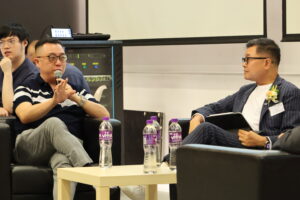
Last Tuesday (June 23), I had the privilege of serving as a panelist at Saint
HKOEA Consultancy
Licence No. 59684
© 2026 Artificial Intellegence Application Research Society. All rights reserved
by Originals Group – Hong Kong, Malaysia, GBA