
The Rise of OPC Hubs: What Is Truly New When They Are Just Business Centres?
By Michael C.S. So | AiX Society My first reaction was, quite bluntly: What exactly
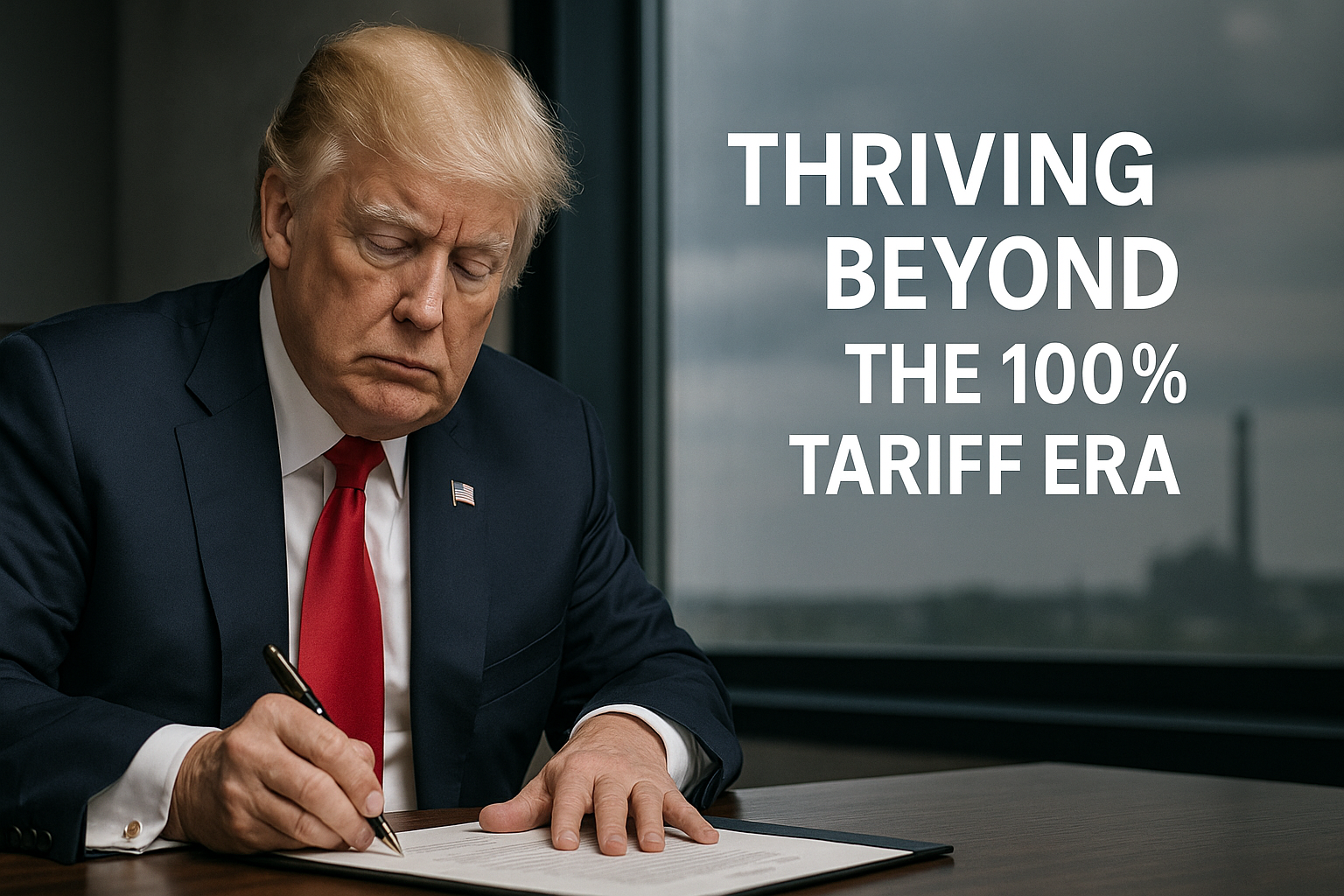
When the new round of U.S.–China tariffs takes effect in November, it will not merely change the price tags on goods crossing borders. It will fundamentally reshape the cost structure of global supply chains. For companies in Hong Kong, mainland China, and Malaysia—deeply interconnected through manufacturing, trading, and logistics—the coming months represent a test of adaptability.
The question every CEO will soon face is not only “How do we survive higher tariffs?” but “How do we rebuild competitiveness in a world where efficiency itself is the new currency?”
For decades, Asia’s manufacturing and export ecosystems were built on scale, low labor costs, and logistical agility. Tariffs—once a political weapon—are now becoming a constant economic condition. A 100% tariff essentially doubles the cost of many goods overnight, wiping out price advantages that took decades to build.
Traditional solutions—moving production lines, cutting staff, or squeezing suppliers—no longer deliver sustainable results. Every company is searching for a smarter alternative. The answer lies not in cheaper labor, but in smarter workflows. This is where AI-powered digital operations platforms like DingTalk become essential.
DingTalk, originally built by Alibaba for its own massive ecosystem, has evolved into a comprehensive AI-driven enterprise platform that connects communication, workflow automation, and business intelligence in one place. Unlike traditional collaboration tools, DingTalk integrates AI at the core of daily operations.
Imagine every repetitive task—report compilation, meeting scheduling, customer inquiries, HR approvals—handled by intelligent agents instead of human hands. Administrative noise disappears; decisions are made faster; internal coordination becomes seamless.
This is not futuristic theory. Thousands of Chinese enterprises are already achieving cost reductions of 30% to 50% in operational expenses through DingTalk’s integrated ecosystem. For Hong Kong and Southeast Asian businesses now facing the tariff shockwave, such transformation is no longer optional—it’s existential.
When tariffs rise, profit margins shrink. The only sustainable response is to increase productivity without increasing headcount. This is the logic behind automation, but modern automation goes far beyond machinery—it’s about intelligent coordination.
Let’s break this down:
In short, the more volatile the trade environment becomes, the more valuable an integrated AI operations layer becomes.
Let’s look at three dimensions where DingTalk’s AI features directly impact business performance:
DingTalk’s generative AI assistant, embedded directly in the chat interface, automatically drafts meeting summaries, generates action points, and tracks progress. Managers can ask, “What are the key issues from yesterday’s production meeting?” and receive a structured report in seconds.
Routine workflows—leave applications, reimbursement approvals, purchase requests—can be automated through predefined AI templates. Each process no longer requires multiple manual follow-ups. In a medium-sized enterprise, this alone can save hundreds of man-hours monthly.
Every company accumulates information, but few manage it effectively. DingTalk’s AI automatically organizes corporate knowledge—documents, SOPs, project updates—into searchable formats. Employees can ask natural questions like, “Show me the Q3 pricing strategy for export markets,” and receive relevant files instantly.
This transforms how organizations learn and adapt. Knowledge no longer hides in inboxes or forgotten folders; it becomes a living system accessible to every employee.
With DingTalk’s built-in analytics, management can visualize cost patterns, task efficiency, and project timelines in real time. AI models detect anomalies—delayed shipments, excessive overtime, supplier cost spikes—and alert decision-makers before they become losses.
In an era where tariffs can swing profitability overnight, early detection equals survival.
Hong Kong sits between mainland China’s manufacturing power and global financial capital. Yet many Hong Kong SMEs still rely on fragmented tools—WhatsApp for communication, Excel for records, and manual processes for HR or logistics. These tools create invisible costs: duplicated work, delayed reporting, and data silos.
Adopting DingTalk allows Hong Kong enterprises to connect directly with mainland partners on the same digital infrastructure used by over 25 million Chinese companies. That alignment is strategic. It not only bridges language and workflow differences but also prepares Hong Kong firms for regional AI integration—where automation replaces paperwork, and collaboration replaces hierarchy.
Malaysia is emerging as a beneficiary of supply-chain diversification, yet many factories and service companies there face a digital gap. While they enjoy lower wages, they also struggle with coordination, training, and compliance.
DingTalk’s cloud-based system gives Malaysian teams access to the same AI-driven workflows as Shenzhen or Hangzhou. From factory floor checklists to executive dashboards, every process becomes transparent and measurable. This levels the playing field and attracts more foreign clients who demand operational visibility.
Let’s put numbers behind the concept. Suppose a trading company in Hong Kong employs 50 staff. If DingTalk’s automation and AI tools save each employee just one hour per day, that’s roughly 1,000 productive hours regained per month.
Even at a modest average salary of HKD 25,000, the company effectively creates over HKD 300,000 worth of efficiency gains monthly—without hiring anyone new. Multiply that across a year, and the savings exceed HKD 3.6 million.
Now imagine this across thousands of SMEs. The collective productivity gain could offset a significant portion of the tariff-driven cost inflation across the region.
Technology alone does not change companies; mindset does. The introduction of AI into daily work requires leaders to rethink how people, data, and decisions interact.
Forward-thinking organizations are using DingTalk not just as a tool, but as a training ground for digital intelligence. Every employee—from junior clerk to senior executive—learns to work alongside AI. The result is not replacement but augmentation: people focus on strategy and creativity, while AI handles repetition and precision.
This transformation also nurtures transparency. When information flows openly, accountability rises naturally. Meetings become shorter, reports become visual, and management becomes evidence-based.
In the 19th century, steam power defined industrial competitiveness. In the 20th, it was electricity and computing. In the 21st, AI infrastructure—the invisible layer of algorithms, data flows, and smart systems—will define who thrives and who fades.
Governments can debate tariffs; companies must build resilience. The only meaningful response to rising external costs is internal intelligence. DingTalk’s ecosystem represents that evolution: an enterprise operating system where every action—communication, approval, analysis—is connected and optimized through AI.
As November approaches, the 100% tariff headlines will dominate financial news, but the deeper story is about transformation. The age of cheap trade is ending; the age of intelligent operations has begun.
For businesses across Hong Kong, China, and Malaysia, embracing DingTalk’s AI-driven system is not about chasing trends—it’s about ensuring continuity, competitiveness, and confidence in an unpredictable world.
Those who digitalize their workflows today will not just survive tomorrow’s tariffs; they will own the future of efficient enterprise
By Michael C.S. So | AiX Society My first reaction was, quite bluntly: What exactly
By Michael C.S. So | AiX Society Just how much information does a company generate
Recently, I have been recruiting, and what I am looking for is not just someone
HKOEA Consultancy
Licence No. 59684
© 2026 Artificial Intellegence Application Research Society. All rights reserved
by Originals Group – Hong Kong, Malaysia, GBA