
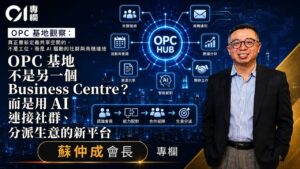
The Rise of OPC Hubs: What Is Truly New When They Are Just Business Centres?
By Michael C.S. So | AiX Society My first reaction was, quite bluntly: What exactly
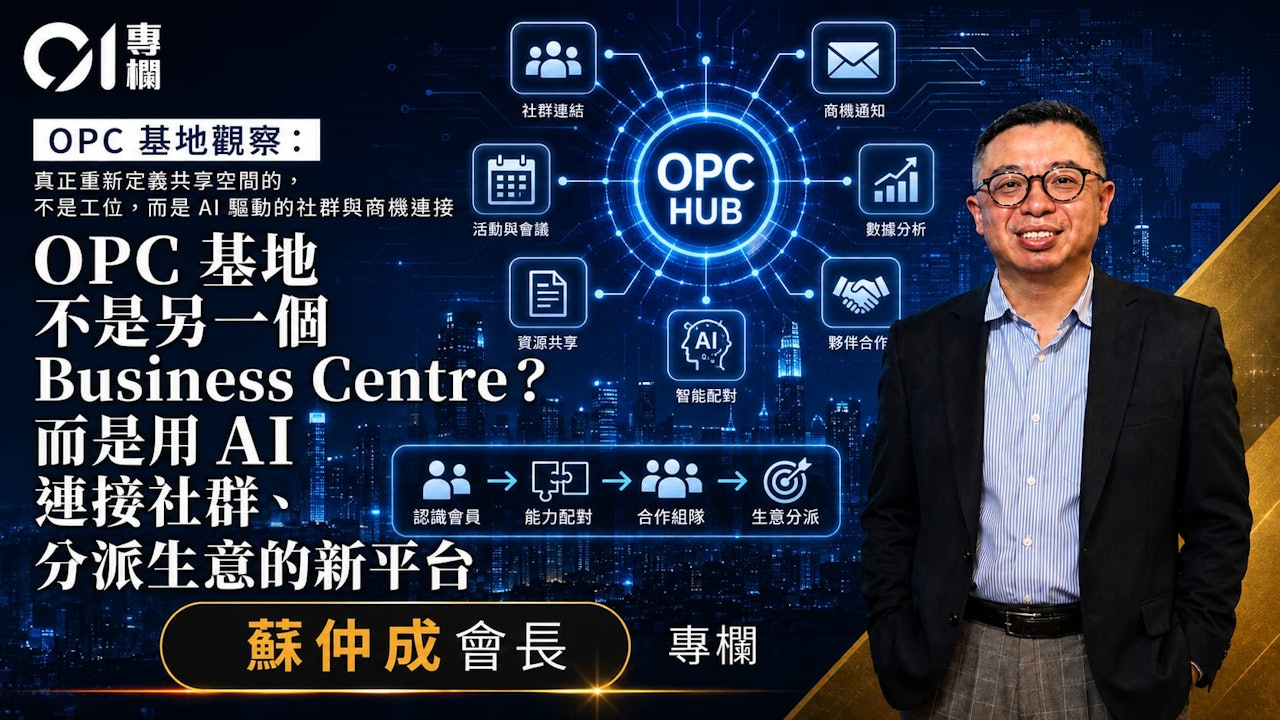
By Michael C.S. So | AiX Society
My first reaction was, quite bluntly:
What exactly is the difference between this and the Business Centre I am sitting in right now?
If an OPC (One Person Company) hub merely offers a desk, a room, an address, plus a few meeting rooms, a pantry and some event space, then — honestly — it has not reinvented anything.
Business centres have been doing this for decades.
Coworking spaces have been doing it for well over ten years.
The question truly worth asking is something else:
Now that we have AI, can we redefine what these places are?
Take the Business Centre I am in right now. There may well be dozens, even a hundred, SMEs inside it.
Yet I have no idea what the company next door does.
And the company next door has no idea what I do.
Upstairs there may be someone who needs AI training, and I am just downstairs.
I may need a designer, and at the other end of the corridor there happens to be a design firm.
Someone may be looking for accounting, marketing, video production, cross-border e-commerce, IT support, or even investors — yet everyone walks in and out of the same building every day without the faintest idea the others exist.
That is, frankly, absurd.
We share the same address, the same lift, the same pantry, even the same coffee from the same machine — yet we never share the things that are most valuable:
our capabilities, clients, needs, knowledge and business opportunities.
This is what got me thinking:
If there were an AI agent that truly “knew” every company inside a business centre, would things be completely different?
Imagine that the data for every tenant company is no longer just a tenancy agreement and a company name.
Instead, we build a dynamic Business Profile:
What does this company do?
What are its specialties?
Which clients does it serve?
What resources does it need?
What business is it looking for right now?
What capacity does it have to take on projects?
If this data is organised by AI, it forms a highly valuable Community Knowledge Graph.
When one company says:
“I need someone to build a website for me.”
AI can answer immediately:
“You have two web companies upstairs — one specialises in SMEs, the other in cross-border e-commerce.”
Another company says:
“I have a client who wants an AI video, but I don’t know how to do it myself.”
AI can reply:
“Three teams in the centre have the relevant capability; I can match you up.”
Going further, AI can even discover opportunities on its own initiative.
For example, it notices that:
Company A has clients but lacks technical skills;
Company B has the technical skills but lacks clients;
Company C understands content;
Company D understands sales.
So could it suggest that the four companies form a project team together?
At that point, a business centre is no longer just leasing office space.
It starts to become a business network.
Many people hear “OPC” and easily misunderstand it as:
“One person starts a company and does all the work alone.”
I would argue the exact opposite.
A One Person Company in the age of AI is not about turning one person into a superhuman.
It is about letting one person — through AI agents and a strong external collaboration network — gain capabilities that only medium-sized enterprises used to have.
One person can have an AI researcher, an AI marketing assistant, an AI content creator and AI customer service.
But when genuinely professional work is needed, they can still find real people to collaborate with.
So the strongest OPC hub of the future should not simply be a building full of One Person Companies.
It should make it possible for these companies to combine very quickly.
Today you are a one-person company.
Tomorrow, when a large project appears, you can join five other OPCs to form a ten-person team.
Once the project is finished, everyone goes their separate ways again.
The company shifts from a fixed organisation to a dynamic network.
And AI is the coordination layer in the middle.
This is why I believe the real breakthrough for an OPC hub should not be “space”.
It should be three things:
First, Community.
Not holding networking events and taking a few photos, but genuinely knowing who every member is, what they do and what they need.
Second, Matching.
Pairing demand with capability in real time.
Third, Business Distribution.
This is the most important one.
If an OPC hub is to be genuinely valuable, it should even take the initiative to find business for its members.
For instance, the hub could have its own AI business development agent that searches every day for corporate demand, tenders, government projects, market collaborations and business opportunities.
It then automatically recommends projects to the most suitable companies based on their capabilities.
It could even take on a large project itself and split it among different OPCs.
If it reaches that stage, I believe an OPC hub genuinely separates itself from a business centre.
Because a business centre earns rent.
An OPC platform creates transactions.
The KPI a traditional business centre cares about most is occupancy rate.
How much space has been rented out?
How much revenue per square metre?
How long does a tenant stay on average?
But for the next-generation OPC hub, I believe the KPIs should be completely different.
For example:
How many collaborations have taken place between members?
How many business matches are generated each month?
How much business has been brought to members?
How many project teams were formed because of the hub?
Six months after joining, have members’ revenues risen?
These are the numbers that actually matter.
I would even put it more bluntly:
The most successful OPC hub of the future may not be the one with the highest rental income, but the one where members’ businesses grow fastest.
Sitting in a business centre in Admiralty, I feel more than ever that Hong Kong is well suited to developing this model.
Because Hong Kong has a huge number of SMEs, professionals, freelancers, consultants and small companies of one or two people.
Their problem is usually not a lack of ability.
It is that they are too scattered.
Some have clients but no manpower.
Some have capability but no clients.
Some have products but don’t understand marketing.
Some understand marketing but have no products.
Today we have already put these people into the same building.
What is missing is simply an intelligence layer.
It was impossible before, because no single person could remember the capabilities and needs of several hundred companies every day.
Today, AI can.
So I increasingly believe that the truly valuable thing about an OPC hub is not “providing office space for one-person companies”.
It is using AI to connect many one-person companies into an invisible large company.
Each person keeps their own brand, freedom and profession.
But when business appears, they can combine instantly.
When resources run short, they can cover for one another.
When someone has an opportunity, it can flow through the whole community.
This is the OPC model truly worth looking forward to.
I would even put it in a single sentence:
A business centre sells space; the next-generation OPC hub sells “the probability of business happening”.
If you simply swap the sign for an “OPC” one and keep renting out rooms, there is no revolution.
But if AI can help several hundred companies in the same space — who previously did not know each other — start to know one another, collaborate, distribute business to each other, and even jointly take on projects,
then what we are redefining is not just a shared workspace.
It is a genuine AI-powered business community.
Originally published in Chinese on HK01 (香港01). Read the original article here.
By Michael C.S. So | AiX Society My first reaction was, quite bluntly: What exactly
By Michael C.S. So | AiX Society Just how much information does a company generate
Recently, I have been recruiting, and what I am looking for is not just someone
HKOEA Consultancy
Licence No. 59684
© 2026 Artificial Intellegence Application Research Society. All rights reserved
by Originals Group – Hong Kong, Malaysia, GBA