

Thank you to Saint Francis University, Joanna Kwok 郭美德 for her invitation!
Last Tuesday (June 23), I had the privilege of serving as a panelist at Saint
Originally published in Chinese on HK01 on March 15, 2026 | By Michael C.S. So | AiX Society
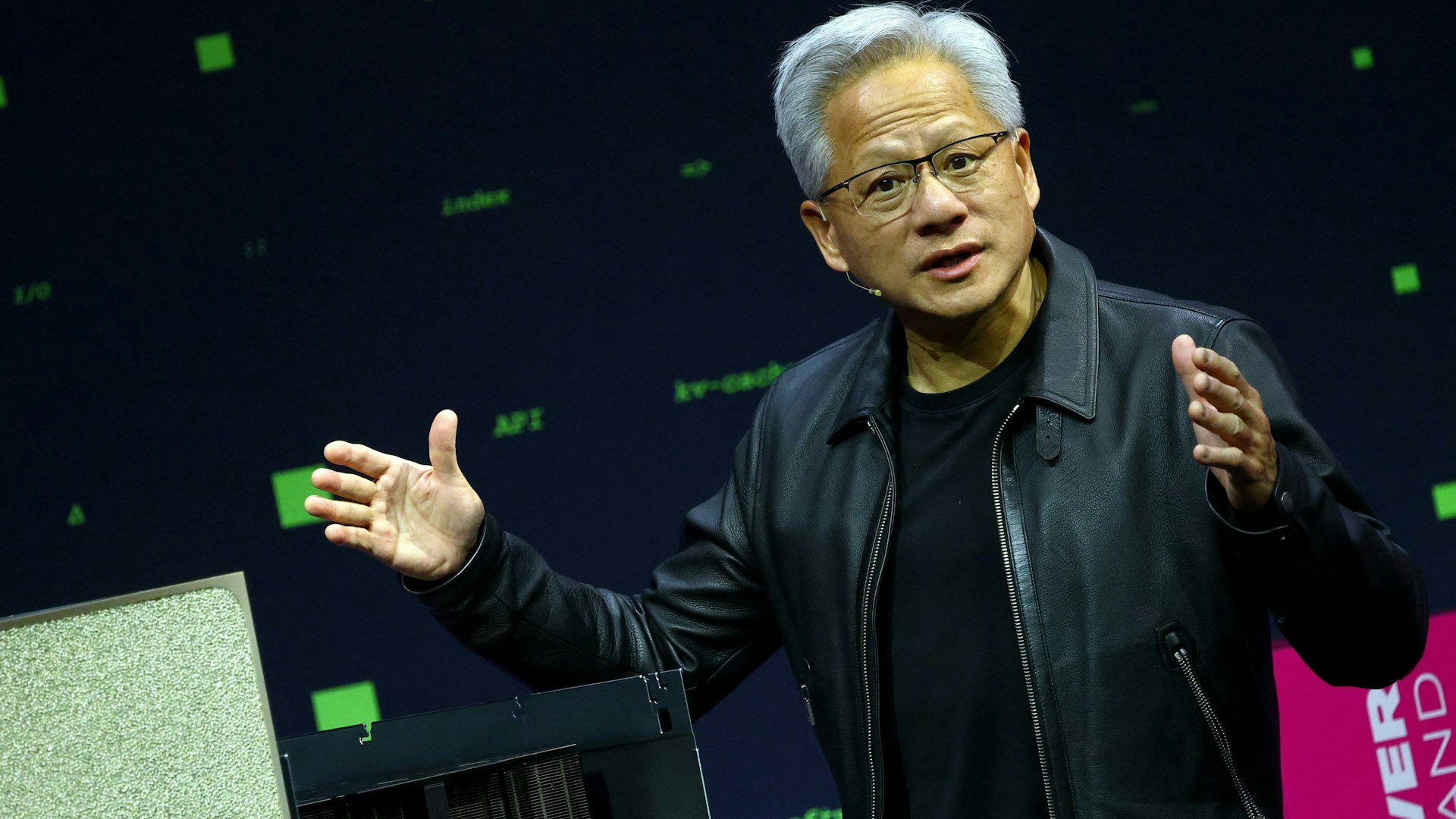
As a business leader, you have probably grown tired of hearing every AI vision and doomsday prediction under the sun. Two opposing voices coexist in the market: on one side, the anxiety-peddling mantra of “go all-in on AI or be left behind,” and on the other, the dismissive “this is just another tech bubble.” A recent interview with NVIDIA CEO Jensen Huang offers a thinking framework that transcends this binary — instead of asking “Is AI a bubble?”, we should ask “Do we truly understand the nature of this computing revolution?”
According to Jensen Huang’s perspective in the interview, when your team excitedly demonstrates the astonishing capabilities of ChatGPT or Claude, as a decision-maker, you need to see the deeper structural changes at work. He explicitly pointed out: “This is Grok, this is OpenAI, this is Anthropic, …”
Huang further emphasized: “If you factor this in, you’ll come to the conclusion that the remaining fuel needed to drive this AI revolution is not only far less than you imagine, but all of it is justified.” What does this mean for CXOs? In the past, when we evaluated IT investments, we were accustomed to assessing them based on…
More specifically, what Huang means by “the remaining investment is far less than imagined” is actually describing an investment sweet spot: the scale effects of infrastructure have already taken hold, and competition among cloud service providers and hardware vendors has drastically lowered the barrier for enterprises to access AI computing power. This doesn’t mean investment has become cheap, but rather…
As someone responsible for the P&L, what you need is a verifiable decision-making framework — not a technology vision. Consider evaluating AI investment timing and depth across these three dimensions:
What proportion of your core operational processes are built on “labor-intensive but rule-based” decision-making? Supply chain forecasting, quality inspection, customer segmentation, inventory scheduling — these are precisely the sweet spots for AI replacement and augmentation. The key isn’t how advanced the technology is, but how well-digitized your process data is…
This is the most frequently underestimated factor. After deploying an AI system, do your frontline managers and employees have the ability to interpret model outputs and handle edge cases? Is your IT team operations-oriented or engineering-oriented? The operational complexity of accelerated computing environments is far higher than traditional architectures — without the corresponding talent density, even the most advanced…
Where does your industry stand on the AI adoption timeline? Have first movers already built data moats, or is everyone still at the same starting line, figuring things out? This determines your investment cadence. In highly regulated or relationship-driven industries, being overly aggressive may backfire; but in data-driven competitive arenas, the opportunity cost of waiting can…
Huang’s reference to “accelerated computing reducing costs” carries another layer of meaning for CXOs: the economic model of AI infrastructure is shifting from CapEx to OpEx. In the past, enterprises needed to invest millions of dollars upfront in GPU clusters; now, they can access them on-demand through the cloud, converting fixed costs into scalable…
This changes the rules of the investment evaluation game. You don’t need to make a one-time, all-or-nothing capital expenditure bet. Instead, you can adopt a rolling investment strategy of “experiment — validate — scale.” It is recommended to divide your AI budget into three pools: 20% for exploratory proof-of-concept (with tolerance for failure), 50% for validated scenarios…
This allocation reflects the inherent uncertainty of AI investments. We cannot predict which application will become the killer use case, but what we can be sure of is that zero investment will lead to an irreversible loss of competitiveness. Huang’s perspective gives us confidence: investment in underlying infrastructure is “justified and rational” because it…
Acknowledging that the market contains elements of a bubble does not mean refusing to invest. The smart approach is to establish rational anchors within the bubble. Specific recommendations include: setting clear stage-gate milestones (for example, achieving a specific automation rate for a given process within six months), establishing control-group comparison mechanisms against traditional approaches, and reserving room for technology roadmap…
Be especially wary of “AI for AI’s sake” projects. When business units submit AI requests, ask three questions: Can this problem be solved without AI? How much better is the cost-benefit ratio of the AI solution compared to traditional methods? Do we have the capability to continuously maintain and optimize this AI system? These three…
Huang’s perspective reminds us that bubbles typically appear in the over-hyped application layer, not in the real demand at the infrastructure layer. While investors chase the next hot AI startup, business operators should focus on the long-term migration trend of computing architectures. This ability to distinguish between the two is exactly what it takes to navigate through cyclical volatility.
Returning to the opening question: Is now the time to invest in AI for daily operations? According to Huang’s perspective, the underlying computing revolution has passed the “proof of concept” stage and entered the inflection point of “scaled deployment.” For CXOs, this means the excuses for waiting are disappearing — but the risks of blindly following the herd remain.
The most pragmatic stance is this: treat AI as the next generation of operational infrastructure, not a magic solution. Just like the spread of electricity or the internet before it, the ultimate winners won’t be the earliest adopters, nor those who watched from the sidelines the longest, but the enterprises that deeply integrate new technology with their own operations and continuously iterate and optimize.
Right now, what you need is not faith in or skepticism of AI, but a clear investment roadmap — one that maps out your organization’s data maturity, process automation potential, talent gaps, and competitive pressures. Then, on that map, rationally draw the first line. The “accelerated computing” revolution that Huang describes provides this map with…
In this sense, the AI bubble debate may well be a false premise. The real question is: in an era of democratized computing power, is your enterprise ready to be an efficiency leader, or content to remain a follower? This choice will determine the competitive landscape for the next five years.
Last Tuesday (June 23), I had the privilege of serving as a panelist at Saint

In recent years, a striking term has emerged in the technology world: biocomputing. At first

誠邀各位企業創辦人、CEO、CXO、CTO 及管理層參加 AiX Society 領袖交流早餐會。 在 AI First 時代,企業正面臨前所未有的轉型機遇與挑戰。我們將透過輕鬆而深入的早餐交流,分享 AI Agent、Digital Workforce 及企業 AI 轉型的最新趨勢與實戰經驗,並與來自不同行業的企業領袖建立高價值人脈網絡。
HKOEA Consultancy
Licence No. 59684
© 2026 Artificial Intellegence Application Research Society. All rights reserved
by Originals Group – Hong Kong, Malaysia, GBA