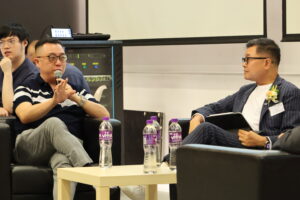
Thank you to Saint Francis University, Joanna Kwok 郭美德 for her invitation!
Last Tuesday (June 23), I had the privilege of serving as a panelist at Saint
As artificial intelligence continues to migrate from software into physical devices, enterprise collaboration is entering a new phase — one where hardware becomes the front door to AI productivity. DingTalk’s latest innovation, the A1 AI hardware device, is a strong signal of this shift. Rather than positioning AI as merely an app feature, DingTalk is embedding intelligence directly into a purpose-built recorder designed to capture, understand, translate, and structure human conversation in real time.
Two standout capabilities define this upgrade: Instant Translation and Graphic & Text Meeting Summary. Together, they transform meetings from passive conversations into structured, multilingual knowledge assets — automatically generated with minimal human intervention.
For organizations managing distributed teams, cross-border operations, or high volumes of meetings, the implications are substantial.
DingTalk has long been recognized as an enterprise communication platform, but the A1 marks a strategic evolution: AI is no longer confined to the cloud — it now starts at the point of capture.
The A1 is best understood as an intelligent meeting companion. Compact and portable, it functions as an AI recorder that integrates tightly with the DingTalk ecosystem. Once placed on a conference table or carried into an interview, the device listens, processes speech, and activates AI workflows automatically.
This hardware-first approach offers an important operational advantage: better audio fidelity and contextual capture. Unlike laptop microphones or phone recordings — often compromised by distance, noise, or overlapping speakers — a dedicated device improves transcription accuracy, which is the foundation of every downstream AI function.
In short, better input produces smarter output.
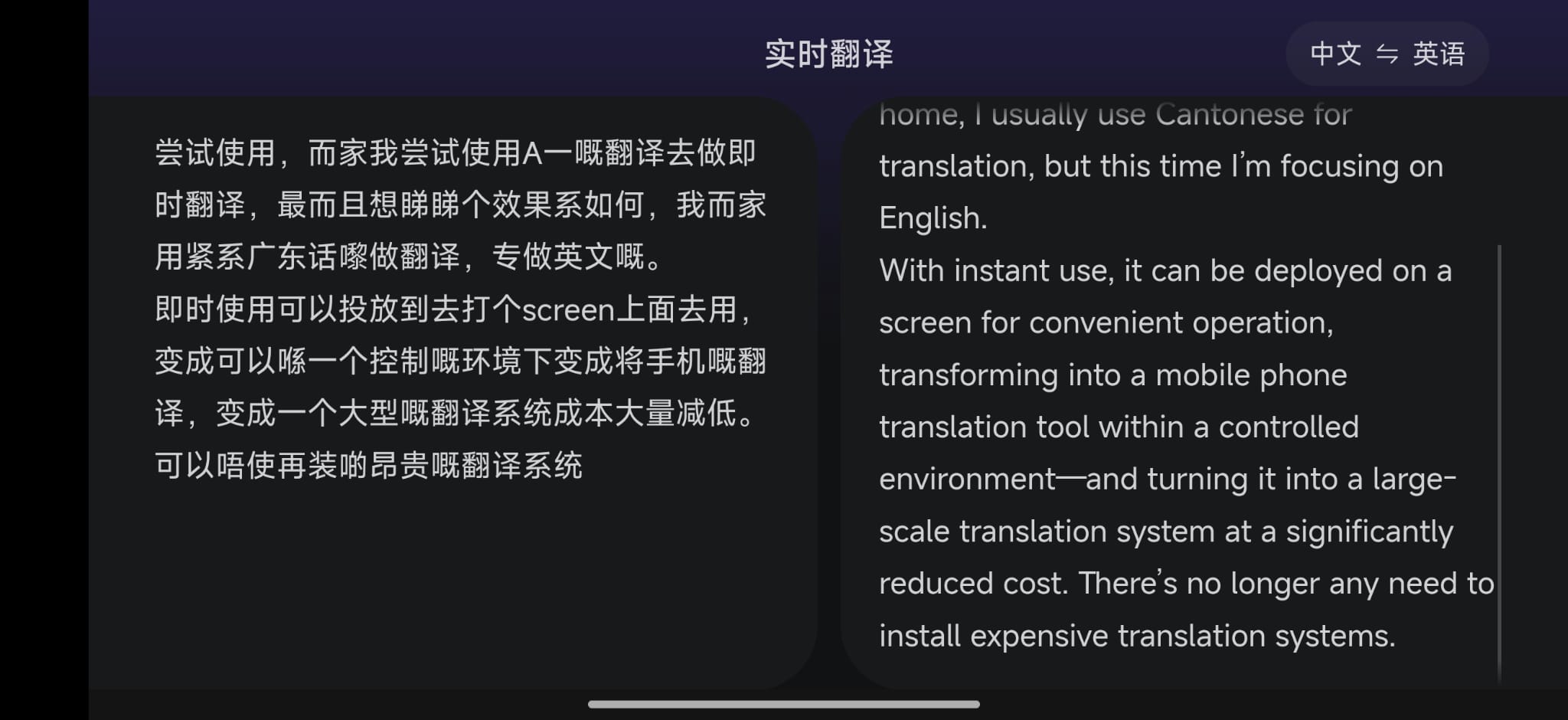
One of the most impactful capabilities of the A1 is its real-time translation engine, designed to eliminate language friction in professional environments.
The device captures live speech and sends it through advanced speech recognition and language models. Within seconds, spoken dialogue is converted into translated text that participants can read on connected displays or within DingTalk.
Key strengths include:
Instead of pausing for interpretation or relying on bilingual participants, teams can communicate fluidly — almost as if everyone were speaking the same language.
Imagine a product strategy meeting involving executives in Hangzhou, engineers in Singapore, and partners in Kuala Lumpur. Previously, such sessions might require interpreters, post-meeting translation, or fragmented notes.
With A1, participants speak naturally while translated subtitles appear instantly. Decisions happen faster. Misunderstandings drop. Momentum builds.
For companies expanding into Asia-Pacific markets — particularly those bridging China with international operations — this capability alone can compress decision cycles dramatically.
If translation removes barriers during meetings, DingTalk’s Graphic & Text Meeting Summary ensures that insights do not evaporate afterward.
Traditional meeting minutes suffer from three persistent problems:
The A1 tackles all three.
After recording a meeting, DingTalk’s AI automatically:
The result is not merely a transcript — it is decision-ready documentation.
The addition of graphical summaries is particularly forward-looking. Executives and project leaders increasingly prefer scannable intelligence over dense paragraphs.
A visual map showing how ideas connect — alongside a clean bullet summary — allows stakeholders to grasp outcomes in minutes rather than rereading hours of dialogue.
This effectively turns meetings into reusable organizational memory.
Most major collaboration platforms now offer some level of transcription or AI summarization. However, DingTalk’s differentiation lies in device-integrated intelligence.
DingTalk’s A1 introduces a dedicated hardware layer — improving audio capture and triggering AI workflows automatically.
Slack focuses heavily on asynchronous communication. While it integrates AI assistants, it is not optimized around voice capture or meeting intelligence.
By combining hardware + AI + workflow integration, DingTalk is moving toward what could be called a full-stack meeting architecture — controlling the experience from sound capture to knowledge distribution.
That is a notably different strategy from software-only competitors.
Companies entering new markets can conduct negotiations without language delays, reducing reliance on interpreters and accelerating partnership cycles.
Automatically generated summaries can be shared with clients immediately after workshops — reinforcing professionalism and reducing administrative overhead.
Board meetings and executive reviews become searchable knowledge repositories rather than isolated conversations.
HR teams can focus on candidates instead of note-taking, while AI captures structured evaluation material in the background.
Across these scenarios, the value proposition is clear: less manual work, faster clarity, stronger institutional memory.
The A1 is not just a product launch — it hints at a broader industry trajectory.
We are entering an era where workplace tools are increasingly AI-native from the hardware level upward. Just as smartphones redefined mobile productivity, intelligent enterprise devices may redefine how knowledge work is captured and operationalized.
Meetings, historically ephemeral, are becoming data streams that AI can analyze, structure, and integrate into workflows.
In that context, DingTalk is positioning itself not merely as a collaboration platform but as an intelligent operating layer for organizations.
The combination of instant translation and automated graphic summaries suggests a future where:
For leadership teams thinking strategically, the question is no longer whether AI will enter meeting rooms — it already has.
The real question is which organizations will adapt their workflows quickly enough to capture the productivity upside.
DingTalk’s A1 provides a glimpse of that near future: a workplace where conversations are understood in real time and converted into structured action without friction.
And if this trajectory continues, the humble meeting recorder may soon become one of the most valuable AI employees in the room.
Last Tuesday (June 23), I had the privilege of serving as a panelist at Saint

In recent years, a striking term has emerged in the technology world: biocomputing. At first
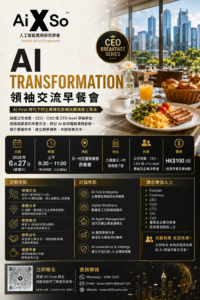
誠邀各位企業創辦人、CEO、CXO、CTO 及管理層參加 AiX Society 領袖交流早餐會。 在 AI First 時代,企業正面臨前所未有的轉型機遇與挑戰。我們將透過輕鬆而深入的早餐交流,分享 AI Agent、Digital Workforce 及企業 AI 轉型的最新趨勢與實戰經驗,並與來自不同行業的企業領袖建立高價值人脈網絡。
HKOEA Consultancy
Licence No. 59684
© 2026 Artificial Intellegence Application Research Society. All rights reserved
by Originals Group – Hong Kong, Malaysia, GBA