
AI Office Automation Daily Briefing — June 10, 2026
Covering the latest developments from DingTalk, Lark/Feishu, WeCom, Microsoft 365, Google Workspace, and the AI

Not long ago, in a meeting room on the upper floor of a commercial building in Admiralty, the board of directors of a major conglomerate was discussing their digital transformation plan for 2026. The table was filled with proposals from various suppliers, and everyone was drinking coffee while discussing how “automation can make processes faster,” “how AI can assist with approvals,” and “how documents can be managed more easily.”
By Michael C.S. So | AiX Society
But when the IT Director turned to the page on the server architecture of the system, the room suddenly fell silent. He looked up and asked in an unambiguous tone:
“Where is the server? Are all documents stored within mainland China? Are backups also in mainland China?”
Once the question was asked, even the CFO stopped writing. Because everyone understood that the answer to this question would determine whether the entire project could be implemented.What Companies Really Fear is Not “Transformation,” But “Invisible Risks”
In the past, when enterprises discussed systems, the primary considerations were often about functionality:
Are the processes fast?
Is the interface user-friendly?
Can it help departments save manpower?
But in the past two years, what companies really worry about has become data sovereignty — where the data goes, who can see it, whether it crosses borders, whether it will be read by models, and whether it complies with local and mainland laws.
Especially for some financial, healthcare, insurance, and logistics companies, if data “takes one wrong step,” the consequences may not be a technical error, but regulatory risk, and may even affect licenses.
A bank CIO once said to me a very serious statement:
“Now all technology issues are essentially compliance issues.”
If even the geographical location of the server cannot be clearly stated, no matter how beautiful the automated process is, it has no meaning.Office Automation Systems: Companies Think They’re Buying Efficiency, But They’re Actually Buying Sovereignty
When enterprises discuss OA systems on the surface, they talk about efficiency — faster leave applications, smoother approvals, easier document retrieval;
But what enterprises really ask in private is:
“Will this system see too much?”
“Are we willing to let it know all our processes?”
“Will it take away our corporate knowledge?”
Because office automation systems will touch:
In other words, enterprises are not weighing the functions of a system, but weighing whether they are willing to entrust “the soul of the enterprise” to a platform for safekeeping.
This is not an exaggeration, but the real anxiety I have seen time and time again in different corporate meeting rooms.The Three Sharpest Questions All Enterprises Are Asking
Whenever I introduce systems to enterprises, they will eventually return to these three questions:
Enterprises want not vague answers, but black-and-white proof.
This involves the intersection of the Cybersecurity Law, Data Security Law, Personal Information Protection Law, and Hong Kong’s local PDPO.
To put it bluntly: Can data be moved out of mainland China? Not even for a minute.
Enterprises are concerned about:
Documents are not just documents, but corporate responsibility.
One of the biggest fears in 2026 is data being quietly used to train models.
No enterprise is willing to let AI read their customer data and internal knowledge.Why Is Transparency More Frightening Than Efficiency?
Many enterprises think they need “more automated processes,”
But when the system is implemented, they discover that what they really fear is actually “transparency.”
Because once a system has audit capabilities, it will mercilessly reveal the truth, including:
I once saw an enterprise that, after implementing a system, learned for the first time that:
Certain approval authorities had been in the hands of a middle manager for many years;
Certain HR documents could be viewed by multiple people, completely non-compliant with regulatory requirements;
Some procurement records had no audit trail, and it was impossible to find out who had made changes.
The system makes enterprises naked.
And nakedness is not something all management is willing to face.Enterprise Upgrades in 2026: Not Upgrading Technology, But Upgrading “Certainty”
At the end of the day, enterprises really need only three things:
(1) Certainty of where data is located
Server location, backup area, cross-border policy, all must be written clearly.
This is the “condition zero” before all functions.
(2) Certainty of who can see what
Permissions are no longer by department, but by:
Document stage / Process node / Weight level / Whether downloadable / Whether shareable.
(3) Certainty that data will not leave the controllable range
Enterprises need to know:
Enterprises are willing to hand over data, but the premise is: everything operates within controllable boundaries.When Enterprises Are Willing to Bear Being Seen, Office Automation Systems Truly Begin to Exert Their Power
I often say to clients:
“Automation doesn’t make you more efficient, automation only magnifies what you already are.”
If an enterprise has discipline, systems, and compliance culture,
The system will make these advantages shine like they’ve been highlighted.
But if the enterprise has chaotic processes, unclear permissions, and scattered data,
Office automation systems will only turn chaos into “quantifiable chaos.”
2026 is a year enterprises must face. AI will accelerate, automation will become widespread, and cross-regional collaboration will become the norm.
However, no matter how technology evolves, one thing will never change:
Corporate data is the soul of the enterprise. To whom the soul can be entrusted is always the most important decision for management.
Article originally published in Traditional Chinese on HK01.
Covering the latest developments from DingTalk, Lark/Feishu, WeCom, Microsoft 365, Google Workspace, and the AI
Covering the latest developments from DingTalk, Lark/Feishu, WeCom, Microsoft 365, Google Workspace, and the AI
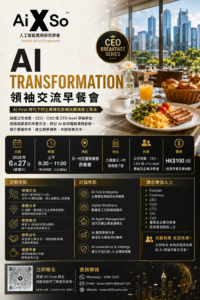
誠邀各位企業創辦人、CEO、CXO、CTO 及管理層參加 AiX Society 領袖交流早餐會。 在 AI First 時代,企業正面臨前所未有的轉型機遇與挑戰。我們將透過輕鬆而深入的早餐交流,分享 AI Agent、Digital Workforce 及企業 AI 轉型的最新趨勢與實戰經驗,並與來自不同行業的企業領袖建立高價值人脈網絡。
HKOEA Consultancy
Licence No. 59684
© 2026 Artificial Intellegence Application Research Society. All rights reserved
by Originals Group – Hong Kong, Malaysia, GBA